
People have long debated what happens after death across major world religions, including Christianity, Judaism, Islam, Hinduism, and Buddhism.
Within these discussions, the question of Heaven vs Hell often becomes a central lens through which people explore justice, morality, and the fate of the soul.
The key difference usually lies in how each realm is described and what it represents: heaven is commonly portrayed as eternal peace, joy, and closeness to the divine, while hell is associated with separation, suffering, or punishment.
Although the imagery and emphasis vary by tradition, both concepts are frequently tied to a person’s choices, actions, and spiritual state.
Each faith offers its own perspective on the afterlife and the path to a favorable outcome—whether through belief, repentance, righteous living, spiritual practice, karma, or enlightenment—making the topic both deeply personal and universally compelling.

In Christianity, heaven is depicted as a place of eternal peace where believers are rewarded for their faith. In contrast, hell serves as a warning for those who turn away from God.
Judaism offers a more varied view, including concepts like Gan Eden for the righteous and Gehenna for purification. Meanwhile, Islam describes paradise as a garden of bliss and hell as a place of torment for non-believers.
Hinduism and Buddhism approach the afterlife with ideas of karma and reincarnation. For Hindus, one’s actions directly impact future lives, while Buddhists focus on achieving Nirvana to escape the cycle of rebirth.
Understanding these diverse perspectives on heaven and hell opens a pathway to deeper reflection on morality and existence.
Conceptualizing the Afterlife

Beliefs about the afterlife vary widely across cultures and religions. This section explores distinct views of heaven and hell, along with alternative concepts such as purgatory, reincarnation, and annihilation.
Heaven: A Place of Eternal Bliss
In many religions, heaven is depicted as a paradise where souls experience eternal happiness. This state is often associated with qualities like peace, love, and communion with the divine.
For Christians, heaven may be described as being in the presence of God, where there are no tears or suffering.
Descriptions of heaven often highlight physical landscapes filled with beauty, like lush gardens and streets of gold. Access to this realm typically requires following moral and ethical teachings, representing the concept of a “narrow gate” to eternal life.
Those who achieve this state find a reward for their earthly deeds, living in a state of eternal bliss.
Hell: A Realm of Punishment and Suffering
Hell is generally viewed as a place of eternal punishment for those who commit grave sins. The imagery often includes fire, darkness, and torment, reflecting the suffering of souls.
This concept serves as a warning against immoral behavior, emphasizing the consequences of one’s actions.
Various interpretations exist about hell’s nature, from eternal separation from God to physical pain. In many texts, hell is described as having different levels of suffering, indicating a range of punishments for different sins. This idea reinforces the belief in moral accountability and the impact of one’s choices during life.
Alternative Views: Purgatory, Reincarnation, and Annihilation
Not all belief systems fit neatly into the concepts of heaven and hell.
Purgatory is seen in some Christian traditions as a temporary state where souls are purified before entering heaven. During this time, living believers may pray for the souls to ease their suffering.
Reincarnation suggests that souls are reborn into new bodies, continuing their journey until they achieve moksha, or liberation from the cycle of life and death. This represents a path toward immortality that differs from the traditional views of eternal reward or punishment.
Annihilation is another stance that posits the complete end of existence after death. In this view, there is no afterlife, which challenges traditional beliefs of an eternal soul. Each of these perspectives offers a unique understanding of existence beyond this life, enriching the discourse on the afterlife.
Theological Foundations
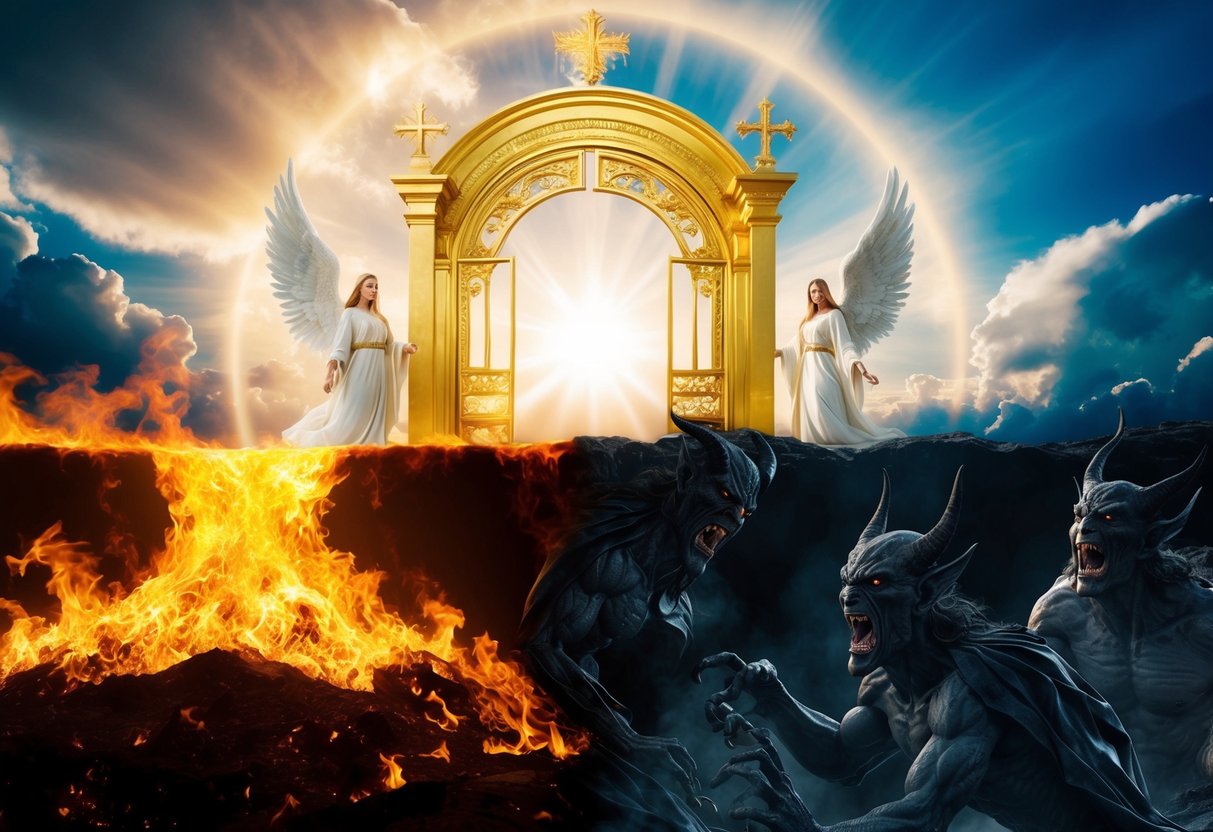
The concepts of heaven and hell are deeply rooted in various religious texts and beliefs. These beliefs shape understandings of judgment and salvation, which vary across different religions.
Heaven and Hell in Scripture
In the Bible, heaven is often described as a paradise where believers dwell with God. Key texts, particularly in the New Testament, emphasize the glory of heaven as a place of eternal life and joy.
For example, Revelation speaks of a “new heaven and new earth” where suffering ceases.
Conversely, hell is depicted as a place of punishment for the unrighteous. Scriptures warn of “eternal separation” from God. Concepts of judgment are significant, as they reveal a belief in the book of life, where names of the saved are recorded.
In the Koran, jannah symbolizes paradise, while jahannam represents a place of torment. These texts present both heaven and hell as determined by one’s faith and actions.
Judgment and Salvation: The Christian Perspective
Christian theology emphasizes that humanity experiences original sin, which creates a separation from God. Through faith in Jesus Christ, believers can attain salvation.
Repentance plays a critical role in this process, allowing individuals to seek forgiveness and restore their relationship with God.
The New Testament discusses a final judgment where all will stand before God. Those who accept Christ’s offer of salvation will enter heaven, while others face condemnation. The importance of baptism is highlighted as a sign of faith and a step towards redemption.
Christians believe in God’s justice, showing that every action has consequences in the afterlife.
Interpretations in Other World Religions
Other religions offer distinct views of the afterlife.
In Hinduism, the concepts of swarga loka (heaven) and naraka (hell) reflect a cycle of reincarnation based on one’s deeds. Actions in one life influence the next, aligning closely with the idea of karma.
Islam contains a similar belief in balance, where deeds affect one’s destination in the afterlife. The Koran details jannah and jahannam, describing rewards and punishments based on faithfulness and morality. Universalism suggests that ultimately, all may achieve salvation.
This perspective varies widely, reflecting diverse understandings of divinity, judgment, and the afterlife across cultures and faiths.
Describing the Indescribable
The concepts of heaven and hell are often explained through vivid imagery and symbolic representations. These descriptions aim to convey experiences that are beyond human understanding. The challenge lies in illustrating these ideas while acknowledging their ultimate mystery.
Imagery and Depictions of Heaven
Heaven is often depicted as a place of immense joy and beauty. Many descriptions feature celestial beings and the glory of God. Visuals may include bright, radiant light, gardens filled with vibrant flowers, and streets paved with gold.
The dwelling place of God is central to these images, emphasizing closeness to the divine. Some believers refer to the seven heavens or firdaws, each representing different levels of bliss. This environment fosters a sense of peace and fulfillment for those who enter. The absence of pain, fear, and sorrow contributes to the idealized state that characterizes these depictions.
Symbols of Hell and Eternal Torment
In contrast, hell is commonly envisioned as a place of suffering and separation from God. Descriptions often include fire, darkness, and scenes of torment. Terms like gehenna or the lake of fire evoke images of unbearable conditions. Weeping and gnashing of teeth symbolize intense regret and despair.
The outer darkness represents alienation from divine presence. It highlights the severe consequences of being apart from God’s love. Imagery of suffering and perpetual pain fills these depictions, focusing on the anguish faced by souls. These symbols serve to underscore the gravity of choices made in life regarding faith and morality.
Experiential Accounts and Cultural Representations
Experiential accounts of heaven and hell often shape cultural beliefs about the afterlife. Personal testimonies and artistic interpretations provide insights into how different cultures visualize these concepts. People share their encounters and creative works, revealing the emotional and spiritual layers of these experiences.
Personal Testimonies and Near-Death Experiences
Many individuals report near-death experiences (NDEs) that offer glimpses into an afterlife. These personal stories frequently include feelings of peace and light, aligning with the idea of heaven as a spiritual place. Witnesses often describe meeting deceased loved ones or experiencing vibrant, comforting environments.
Conversely, some report distressing experiences associated with hell, featuring themes of eternal fire or overwhelming darkness. These accounts suggest a strong connection between consciousness and the soul’s journey after death. Testimonies can profoundly impact beliefs about immortality, shaping perspectives on morality and the afterlife.
Artistic and Literary Interpretations
Art and literature have long depicted heaven and hell, influencing societal views. Works from different eras showcase varying styles and messages.
For example, medieval paintings often illustrate vivid representations of hell’s punishment, using imagery of eternal fire to convey consequences for sin.
In contrast, literary works frequently explore themes of redemption and hope. Writers depict heaven as a place of ultimate joy, where souls find fulfillment and union with the divine. These interpretations shape cultural narratives about life after death and emphasize moral lessons that resonate through generations. Such artistic expressions help culture process and understand deep existential questions.
The Impact on Life and Ethics
Beliefs about heaven and hell significantly shape individual morals and broader societal norms. These concepts influence how people view righteousness, grace, and the consequences of their actions.
Moral Implications of Belief in Heaven and Hell
The belief in heaven and hell creates a framework for understanding morality.
For many, the idea of eternal joy in heaven motivates individuals to pursue a righteous life. This often includes acts of kindness and charity, driven by the hope of divine reward.
On the flip side, the fear of eternal suffering in hell can instill a sense of responsibility in behavior. It serves as a deterrent against immoral acts. Ideas of punishment and shame may lead individuals to consider the consequences of their actions, fostering a concern for righteousness over wrongdoing.
This moral compass not only impacts personal decisions but also influences how communities enforce ethical standards. The concepts of karma or divine retribution may be interwoven into daily interactions and judgments.
Influence on Social and Cultural Norms
Heaven and hell also shape social and cultural norms across communities. These beliefs may encourage the formation of groups, such as congregations, that share common values and ethical standards.
They often instill a sense of belonging and collective expectation. Cultural traditions can revolve around the teachings of grace and the roles of angels and demons.
These narratives can reflect and reinforce societal values surrounding punishment and redemption. Furthermore, these beliefs may influence laws and regulations within societies, as communities aim to uphold values they associate with righteousness.
Fear of the wrath of God can lead to stricter moral codes, while the promise of divine grace can promote forgiveness and acceptance.
