
The story of Adam and Eve is central to the teachings in the Bible, particularly in the book of Genesis. They are often seen as the first humans, created by God and placed in the Garden of Eden.
Many readers of Scripture find themselves wondering: how did Adam and Eve die? This question arises naturally when exploring their journey from paradise to mortality.
Their choice to eat from the forbidden tree introduced the concept of original sin, which altered their relationship with God and the state of humanity.
This single act of disobedience transformed them from immortal beings into mortals, setting the stage for physical death to enter the world.

Adam and Eve ultimately died of old age after being expelled from Eden, but their actions brought about significant spiritual death as well. Their disobedience not only led to their own suffering but also served as a cautionary tale about the consequences of choices.
Understanding how Adam and Eve died invites a deeper look into themes of free will, redemption, and human frailty.
Exploring this topic helps uncover the lasting impacts of their story on religious beliefs and moral teachings. Readers may find their choices mirror challenges faced today, raising questions about accountability and the quest for salvation.
Biblical Account of Adam and Eve’s Lifespan
The biblical lifespan of Adam and Eve provides insights into early human history and serves as a foundation for understanding longevity in biblical narratives. Key passages discuss their creation, life events, and the implications of their ages.
Genesis 5: Creation to Death
Genesis 5 offers a genealogy from Adam to Noah. It records Adam’s lifespan as 930 years (Genesis 5:5), emphasizing the extraordinary longevity attributed to early humans. Adam was created directly by God, which is significant for understanding his role in biblical history.
Eve, though not given a specific age at death, is often presumed to have lived a similar length of time. The text does not elaborate on her death, but it implies a shared fate with Adam.
This chapter sets a precedent for human lifespan, impacting generations that followed. Notably, Methuselah, a descendant of Adam, lived the longest at 969 years (Genesis 5:27), highlighting a period when humans lived significantly longer lives.
Lifespan in Scripture
The lifespans recorded in scripture show a gradual decline over generations. Adam and Eve’s long lives reflect a different era, where human beings had a closer connection to God.
Genesis 2:17 mentions the consequences of disobedience, indicating a shift in human condition after their sin.
After the flood, lifespans decreased markedly. For instance, post-flood patriarchs averaged around 400 years. This change in life expectancy highlights the impact of sin on humanity.
Adam and Eve’s lives set foundational expectations for longevity, shaping religious and cultural narratives about human existence and morality throughout history.
The Nature of Death for the First Humans

The deaths of Adam and Eve represent both physical and spiritual aspects. Their choices in the Garden of Eden set the stage for consequences that affected their lives and humanity.
Understanding Physical Death
In the Bible, Adam lived for 930 years before he died (Genesis 5:5). Eve’s age at death is not specified. Their physical death was a direct consequence of their disobedience in eating the forbidden fruit from the Tree of Knowledge of Good and Evil.
This act introduced mortality into their lives.
The ability to die was not part of the original design for humanity. According to Scripture, they were created to live eternally in paradise. The moment they disobeyed God, they altered their fate, leading to their eventual physical death.
The idea of mortality shifted from living forever to facing mortality.
Spiritual Consequences
Spiritual death occurs when there is a separation from God. The disobedience of Adam and Eve resulted in more than just physical death; it severed their close relationship with the Creator.
This disconnect is seen as the moment sin entered the world.
Eating from the Tree of Knowledge brought awareness of good and evil, but it also resulted in guilt and shame. Spiritual consequences included hiding from God and a sense of alienation.
This spiritual death has implications for all of humanity, introducing a need for redemption.
The narrative of Adam and Eve emphasizes the importance of obedience. Their choices illustrate how actions can lead to both physical death and spiritual separation.
Cultural and Theological Interpretations

Different cultures and religious traditions interpret the story of Adam and Eve’s deaths in unique ways. Each perspective offers insights into their significance and impact on humanity.
Christian Perspective
In Christian tradition, Adam and Eve’s deaths are often viewed both physically and spiritually. They are believed to have experienced spiritual death on the day they ate from the tree of knowledge, as noted in Genesis 2:17.
This act brought sin into the world, which altered their relationship with God. Over time, they eventually faced physical death, as all humans do.
Additionally, St. Paul emphasized the connection between Adam’s sin and human mortality, indicating that through Adam came sin and death, while through Christ comes redemption and eternal life.
The belief in original sin stems from this narrative, highlighting its importance in Christian theology.
Jewish Tradition Explained
Jewish tradition provides a multi-faceted understanding of Adam and Eve’s mortality. The Jewish texts suggest that while they faced death after eating from the tree, they were not immediately killed. Instead, they were exiled from the Garden of Eden, marking a transition to a new life outside of paradise.
The concept of death in Judaism encompasses more than physical demise; it includes a loss of spiritual connection to God. This interpretation leads to discussions about repentance and redemption in Jewish thought.
Moreover, medieval Jewish scholars often debated the implications of this narrative on the human condition and the nature of free will.
Islamic Viewpoints
In Islam, the stories of Adam and Eve (known as Hawwa) hold significant meaning but differ from Judeo-Christian interpretations. They are considered the first humans created by Allah and share a similar narrative of disobedience.
However, in Islamic belief, their sin was not seen as the original fault that doomed humanity. Instead, it was an act of forgetfulness. Upon realizing their error, Adam and Eve repented and were forgiven by Allah.
Death is viewed as a natural part of human life, with a focus on the afterlife. The Quran emphasizes that every soul will taste death, highlighting both accountability and mercy in humans’ journey through existence.
End of Life and Burial Traditions
The final moments and burial practices of Adam and Eve are steeped in tradition and interpretation. Various sources provide insights into where they were laid to rest and the significance of these locations.
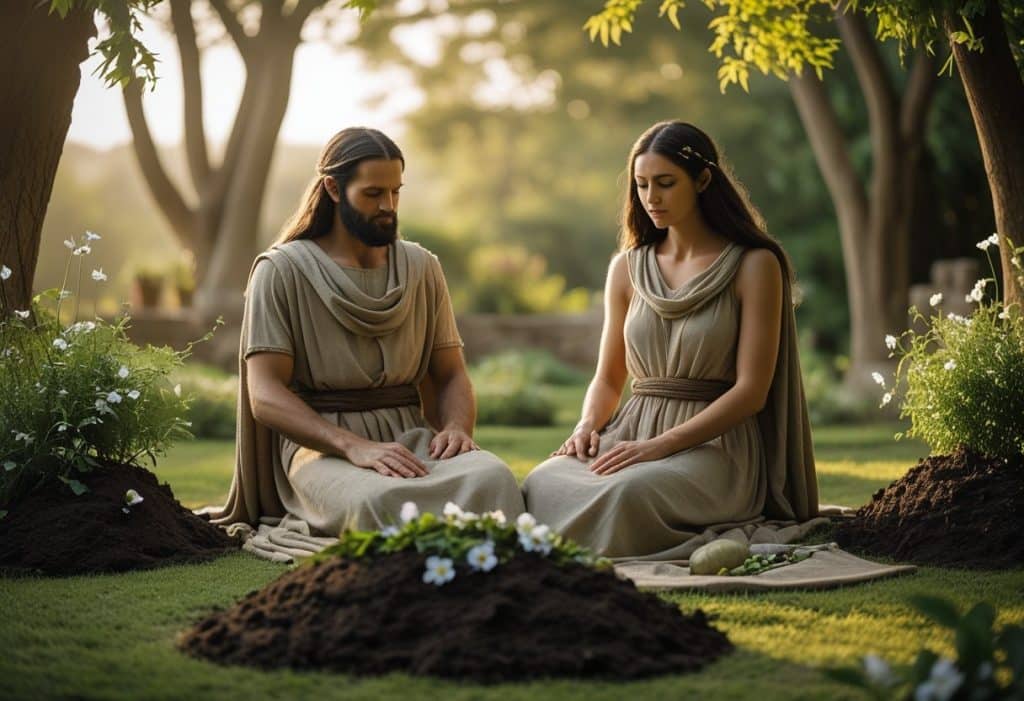
Cave of Machpelah: The Final Resting Place
Many traditions suggest that Adam and Eve were buried in the Cave of Machpelah, located in Hebron. This site holds great importance in Jewish tradition as it is believed to be the burial ground of several biblical patriarchs and matriarchs.
While the Bible does not confirm this specifically for Adam and Eve, Jewish texts mention that they were interred here.
The cave is often called the Cave of the Patriarchs, highlighting its significance as a familial burial site. It symbolizes legacy and continuity for generations.
Tradition further suggests that the location served as a reminder of human mortality and the consequences of sin, as Adam and Eve began their physical decline after eating from the Tree of Knowledge.
Significance of Burial Sites
Burial sites, such as the Cave of Machpelah, carry deep spiritual and cultural significance. For many, these places serve as connections to faith, history, and ancestry.
The burial of Adam and Eve in this cave represents not just their end of life but also the foundation of humanity’s history.
The notion of burial in sacred grounds underscores the belief in life after death and the importance of physical remains. Many traditions emphasize the hope of resurrection or continuity of life beyond physical death.
Thus, the Cave of Machpelah stands as a powerful symbol within the broader narrative of creation and human experience. Its significance goes beyond physical burial, resonating with themes of redemption and connection to God’s plan.
Legacy and Impact on Humanity
The story of Adam and Eve carries significant consequences that shape both human nature and Christian beliefs. Their actions have left a lasting imprint on humanity and influenced theological discussions throughout history.
Imprint on Human Nature
The Fall of Man marked a critical change in human nature. With the disobedience of Adam and Eve, humanity inherited a sinful nature, often referred to as Original Sin.
This belief holds that every person is born with a tendency to sin, separating them from God.
The consequences of sin manifest in various ways. Individuals struggle with inner conflicts, moral dilemmas, and spiritual alienation.
This separation from God has fueled humanity’s search for redemption. The notion of needing rebirth is rooted in this doctrine, impacting countless lives and decisions throughout history.
Influence on Christian Doctrine
The early Church Fathers played a vital role in interpreting the legacy of Adam and Eve. Their writings often focused on the theological significance of the Fall.
They viewed sin as a barrier to communion with God, leading to a deeper understanding of redemption through Jesus Christ, the Second Adam.
This perspective emphasizes that while sin entered the world through Adam, salvation is available through Jesus. His sacrifice offers hope for reconciliation and rebirth for all who believe.
The teachings of these early theologians continue to influence Christian doctrine, shaping beliefs about sin, salvation, and humanity’s relationship with God.
