
The story of Noah and the ark is one of the most well-known tales in history. When exploring this biblical narrative, many people naturally wonder: How long was Noah in the ark?
Understanding the timeline of this extraordinary journey helps us appreciate the magnitude of what Noah and his family endured during the great flood.
According to biblical accounts, Noah spent approximately one year and ten days aboard the ark. This period began when God commanded him to enter with his family and the animals, and ended when the earth had dried enough for them to safely disembark.
The duration was far longer than most people realize, making it a true test of faith and perseverance.He was on the ark for a total of 370 days, from the start of the flood until the first dry land appeared.

This lengthy period tested Noah’s faith and resilience as he cared for his family and the animals on board. Understanding the timeline of Noah’s experience can provide valuable insights into the lessons of patience and trust in divine plans.
Readers will find it interesting to explore the biblical references and scholarly interpretations that shed light on this remarkable story. The details surrounding the flood bring a deeper appreciation for the challenges Noah faced during this extraordinary event.
Noah’s Obedience and the Divine Command
Noah’s actions showcase his strong obedience to God’s command. His willingness to heed warnings and construct the ark is a vital aspect of this biblical story. This reflects his faith and commitment to preserving life.
Heeding the Warning
God warned Noah about an impending flood that would destroy all living things. This warning was significant and detailed.
In Genesis, Noah is instructed to build an ark to save his family and various animal species.
Noah believed the warning and acted without hesitation. Despite facing skepticism and ridicule from others, he remained committed. His faith drove him to prepare for a disaster that had not yet occurred. This unwavering obedience lasted for about 120 years, showing his dedication to God’s commands.
Construction of the Ark
Noah received precise details for building the ark. The dimensions specified were 300 cubits long, 50 cubits wide, and 30 cubits high. He used gopher wood for its construction, which was important for the ark’s durability.
The building process took significant time and effort. Noah gathered materials and worked diligently, following God’s instructions carefully.
This project symbolized not just physical labor but also deep faith in God’s promise of salvation. Each aspect of the ark’s design played a crucial role in ensuring its functionality during the flood.
The Deluge: Genesis Account
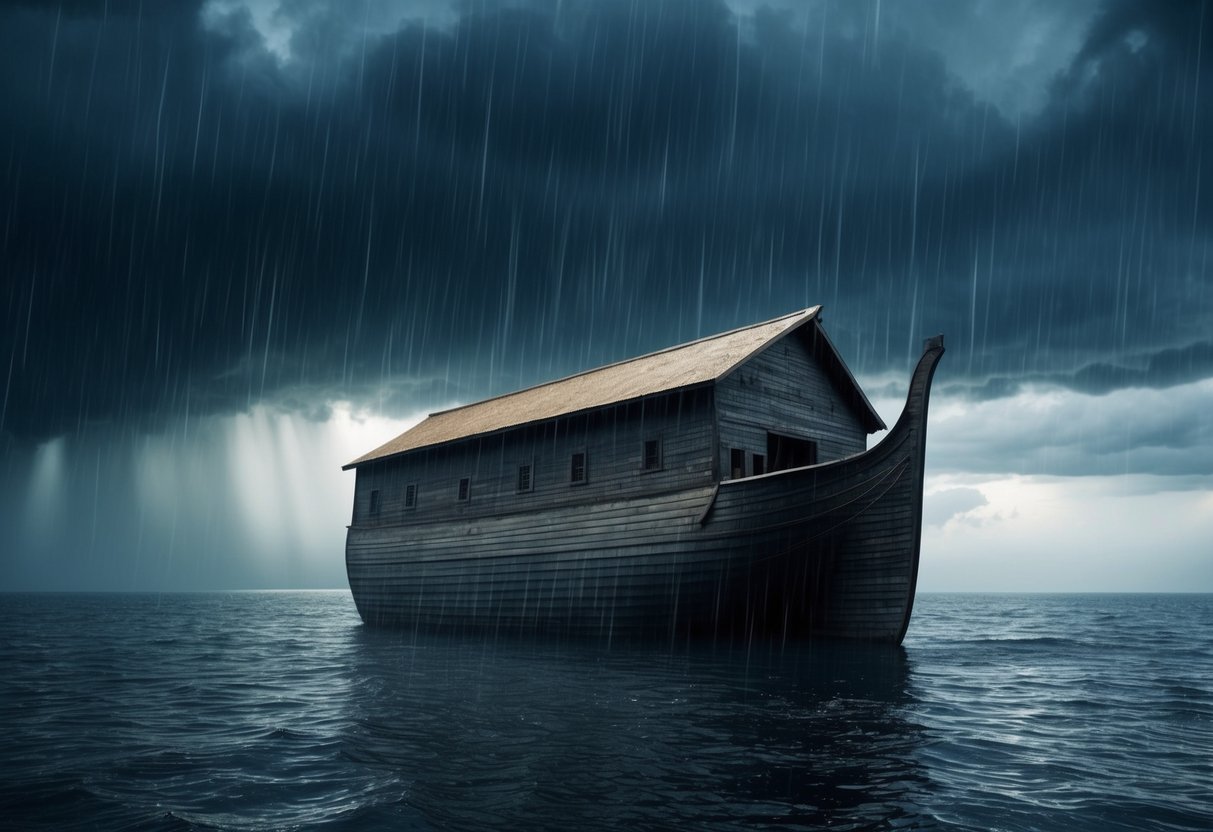
The account of the Deluge in Genesis describes the catastrophic flood that occurred during Noah’s time. It details how the flood began and how the waters covered the earth, impacting all living beings.
Onset of the Flood
The flood began when God instructed Noah to enter the ark. Rain fell for forty days and forty nights, marking the start of the great deluge. According to Genesis, the heavens opened up, releasing waters from above.
Additionally, the fountains of the great deep burst forth. This means that underground water sources also contributed to the flood. The combination of rain and rising waters overwhelmed the land. As a result, all creatures not aboard the ark faced destruction.
Waters Prevail on Earth
The waters of the flood prevailed on the earth for a significant period. As recorded in Genesis, they rose to cover even the highest mountains, reaching fifteen cubits upward. This demonstrates the severity of the flood.
After 150 days, Noah’s ark came to rest on the mountains of Ararat. The floodwaters were still receding, but visibility began to emerge. Eventually, the tops of the mountains became visible. This marked the gradual end of the flood’s impact on the earth and set the stage for the events that followed.
The Duration of the Flood
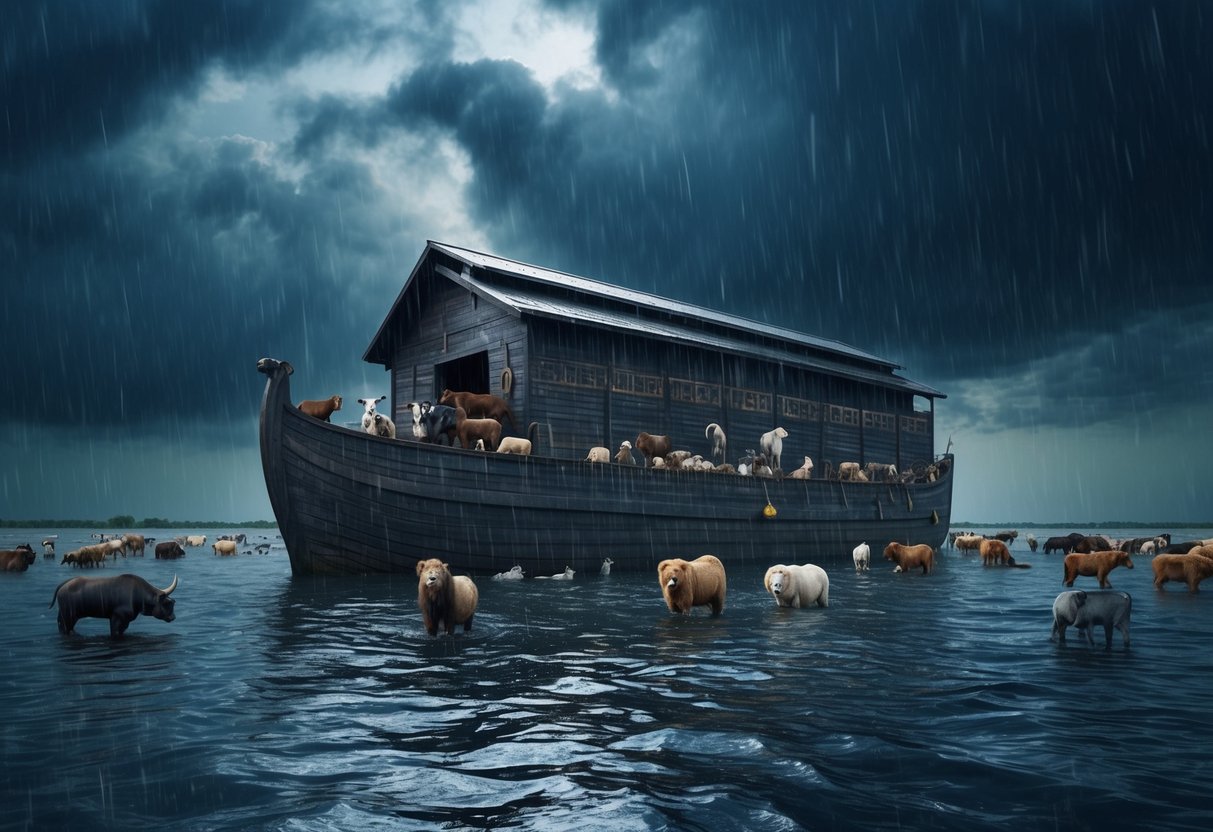
The duration of Noah’s Flood is a key aspect of the biblical narrative. It describes both the arresting and the receding of the waters, detailing how long Noah and those with him were in the ark.
Arresting the Waters
The Flood began when Noah was 600 years old. For forty days and nights, heavy rain fell and the waters prevailed on the earth. During this time, the depths of the earth also opened, contributing to the vast amount of water.
It is recorded that the waters covered the earth to a depth that submerged even the highest mountains. This period marked the peak of the Flood.
After those initial days, the waters remained at full height for a significant time, ensuring that every living thing outside the ark was destroyed. This steady pressure of water signifies the power of this event as described in Scripture.
Receding of the Waters
After the Flood’s climax, the waters began to recede. The process of the waters abating took time and is documented through several key events.
On the 150th day, the ark came to rest on the mountains of Ararat. By the seventeenth day of the seventh month, the surface of the land started to dry.
Noah waited an additional forty days before sending out a raven and later a dove to check for dry land. The dove returned with an olive leaf, which indicated that life was returning to the surface.
This gradual receding of the waters ultimately allowed Noah and his family to disembark, marking the end of their time in the ark.
Signs of the Earth’s Restoration
As the floodwaters began to recede, Noah looked for signs that the earth was returning to a livable state. He used birds to check for dry land and watched as nature slowly reemerged.
Sending Forth Birds
Noah first sent out a raven to assess the environment. The raven flew back and forth, but it did not return immediately, indicating it found food and shelter. This behavior suggested that parts of the earth were possibly becoming habitable again.
After some time, Noah released a dove. The dove returned to him with an olive leaf in its beak, which signified the presence of vegetation.
This moment was crucial as it meant the earth was recovering. Holly leaves indicated that trees and plants were starting to grow once more.
After waiting seven days, Noah sent the dove out again. This time, the dove did not return, confirming that the land was now suitable for life.
Emergence of Dry Ground
The flood began to subside significantly after several months. On the seventeenth day of the seventh month, the ark came to rest on the mountains of Ararat.
By the first day of the tenth month, the tops of the mountains became fully visible. This sight provided hope for Noah and his family, signaling that the worst of the flood was over.
Noah’s actions with the birds were essential in confirming that the earth was ready to be populated again, setting the stage for a new beginning.
Theological Interpretations
The story of Noah and the ark presents deep theological themes, particularly regarding divine judgment and mercy, as well as concepts of covenant and salvation. These themes help readers understand the broader implications of the narrative.

Divine Judgment and Mercy
In the account of Noah, God’s divine judgment is clear. The world had become filled with evil, prompting God to cleanse creation through the flood. This act is viewed as a response to humanity’s moral failure and corruption.
Yet, this judgment is paired with profound mercy. God chose Noah, a righteous man, to save him and his family. By instructing Noah to build the ark, God provided a means of escape from impending disaster. This duality highlights the balance between justice and compassion.
Noah’s household became a symbol of hope amidst destruction. They were preserved to continue God’s plan for humanity, demonstrating that even in judgment, there is room for grace and new beginnings.
Covenant and Salvation
After the flood, God establishes a covenant with Noah, marking a significant moment in biblical theology. This covenant signifies a promise that He would never again destroy the earth by water.
The significance of this promise extends to themes of salvation. The ark represents a vessel of deliverance, symbolizing how faith and obedience can lead to salvation.
Noah’s decision to heed God’s instructions saved his family and the future of creation.
The covenant emphasizes God’s commitment to humanity despite its flaws. As the rainbow became a sign of this promise, it reinforces the idea of hope and renewal in the relationship between God and His creation.
