
The question of Jesus Christ’s height has intrigued many throughout history. When people ask how tall was Jesus, they often seek answers rooted in both faith and historical research, yet the Bible offers no direct details about his physical stature.
Researchers suggest that he was likely between 5 feet 1 inch and 5 feet 5 inches tall, which aligns with the average height of men during his time in first-century Palestine.
This estimate is based on archaeological findings and skeletal evidence from the region.
While scripture remains silent on his appearance, various studies have drawn on historical context to paint a clearer picture of what Jesus may have looked like.

In the realms of Judaism and Christianity, Jesus is central to the faith and his physical appearance often captures interest.
Although his height is not a core teaching in the New Testament, exploring this aspect reveals insights into the life and times of a figure who profoundly impacted history and religion.
Understanding his estimated height can shed light on the cultural setting of his life, offering a glimpse into a world that shaped the teachings and character of Jesus.
Such details help deepen the appreciation of his story as told in the Bible, transcending mere numbers to resonate with faith and belief.
Historical Context of Jesus’ Appearance

Understanding the historical context of Jesus’ appearance involves examining his Jewish ancestry and the cultural clothing of 1st century Judea. These elements reflect the social and religious background that shaped his life in the region.
Influence of Jewish Ancestry
Jesus was born into a Jewish family during the period of Second Temple Judaism. This was a time when Jewish identity was deeply tied to cultural and religious practices.
His ancestors included notable figures from the Old Testament, which influenced his teachings and perceptions.
As a Jew in Judea, Jesus would have adhered to customs, dietary laws, and religious rituals that defined Jewish life.
Biblical scholars note that his appearance and the way he was viewed by others were influenced by Jewish heritage. The expectations within Jewish communities often focused on spiritual leadership rather than physical attributes alone.
Cultural Apparel of 1st Century Judea
The clothing in 1st century Judea reflected local customs and practicality. Men typically wore simple tunics made from wool or linen, which were suitable for the climate in the Middle East.
For Jewish males, these tunics often had fringes at the edges, in accordance with religious teachings. Footwear consisted of sandals, which were practical for walking on dusty roads.
Jesus likely dressed like other men in his society, which would have included Roman soldiers and other locals. His dress would not have been luxurious but functional, signifying his role among the common people in Galilee and Judea.
The absence of detailed biblical descriptions suggests that physical appearance was less significant than his teachings and actions.
Scholarly Reconstructions
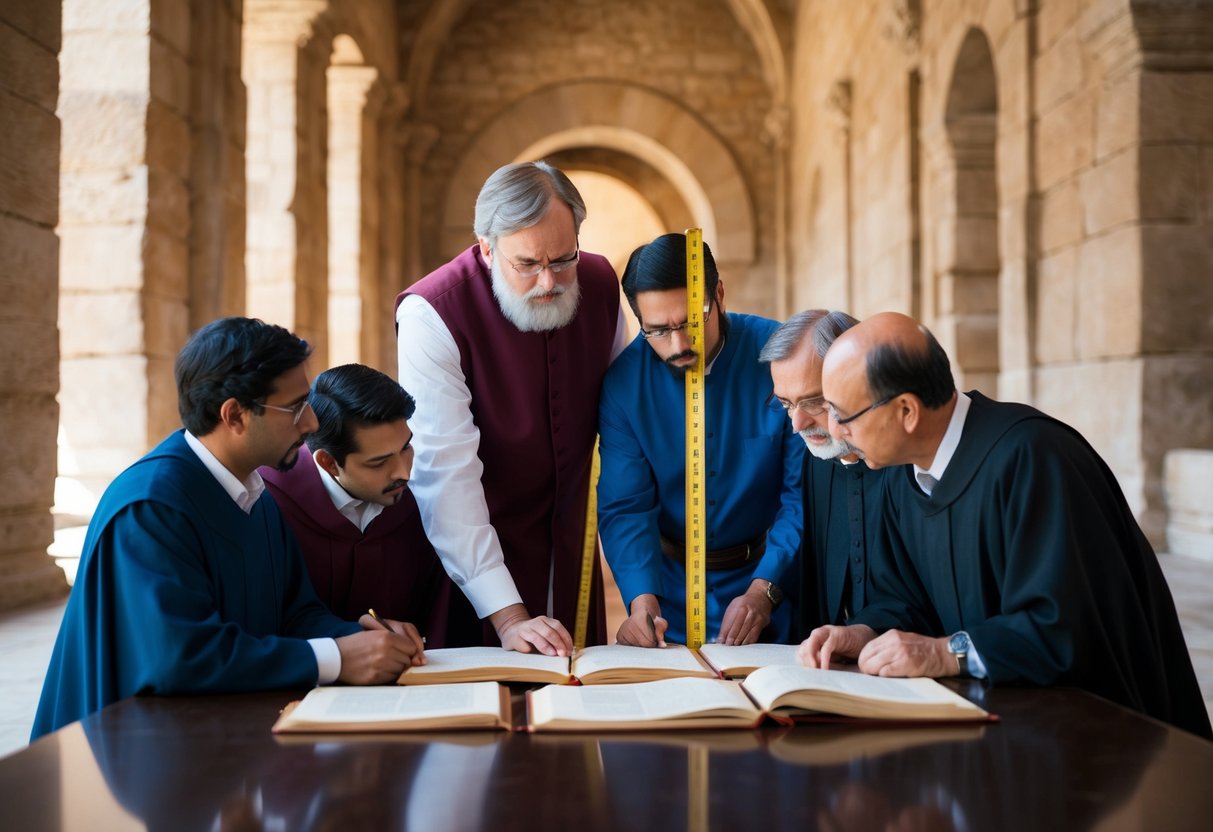
Scholarly reconstructions of Jesus’ height often draw on various fields such as anthropology and archaeology. Insights from these disciplines help paint a clearer picture of what Jesus might have looked like and how tall he was.
Anthropological Insights
Anthropologists study human behavior and physical characteristics. Forensic anthropologists, specifically, analyze human remains to determine physical attributes, including height.
Research indicates that men in 1st century Judea averaged about 5 feet 1 inch to 5 feet 5 inches tall.
Joan Taylor, a prominent scholar, suggests this estimate based on her investigation of historical texts and remains. Taylor emphasizes that understanding the average height helps provide context for Jesus’ life. It also reflects the lifestyle and nutrition of the people during that time.
Different factors like genetics and environment led to the average stature observed in historical populations.
Archaeological Contributions
Archaeology offers significant insights through the study of physical remains and artifacts.
Richard Neave, a British forensic artist, used archaeological evidence to create reconstructions that represent the appearance of people from Jesus’ era. His work often includes estimates based on skull shapes and other skeletal features.
Archaeological findings showcase artifacts that highlight daily life in Judea. This context helps historians understand how Jesus may have fit into his social environment.
The archaeological remains provide a framework for visualizing ancient society, thus informing scholars about what a typical person, like Jesus, might have been like physically. Such studies are essential to building a comprehensive representation of historical figures.
Biblical Descriptions and External References
The height of Jesus is not directly described in the Bible, and most external references do not clarify this either. This section explores what is available in the Gospels and from other historical sources to provide insight into Jesus’ possible height.
Gospels’ Accounts of Jesus
The Gospels—Matthew, Mark, Luke, and John—do not specify Jesus’ physical height. They focus mainly on His teachings and actions as the Messiah.
The only direct mention of physical attributes comes from Isaiah 53:2, which states He had no beauty or majesty that would attract others.
Some scholars use contextual clues to infer His likely height. Based on the average height of men in first-century Israel, it is believed Jesus may have stood between 5’1″ and 5’5″.
Joan Taylor, a scholar on the historical Jesus, supports this estimate, asserting that cultural and geographical factors influenced His physicality.
Non-Biblical Sources
Non-biblical sources, such as writings by ancient historians Tacitus and Josephus, do not provide physical descriptions of Jesus. They focus mainly on His role and impact rather than His appearance.
Some later Christian texts from centuries after Jesus’ time suggest different ideas about His look and stature, but these are not considered reliable historical evidence. They often reflect later theological views rather than factual accounts.
Most serious studies of Jesus’ life focus more on His teachings and significance as a Prophet and less on physical traits, leaving much to speculation.
Physical Attributes
The physical attributes of Jesus can be informed by cultural context, historical data, and artistic interpretations. These aspects include general physiognomy, height considerations, and how he has been depicted through the ages.
General Physiognomy
While the Bible does not provide detailed descriptions of Jesus’s physical appearance, scholars suggest he likely had typical features for a Jewish man of his time.
This could include brown eyes, black hair, and olive-brown skin. His hair may have been shoulder-length, reflecting common styling of the period.
Considering the climate and culture, Jesus likely wore simple clothing, consisting of a tunic and a cloak. He may have also worn sandals, which were standard footwear in that era.
These elements are important in understanding how he would have appeared to those around him.
Height Considerations
Estimates of Jesus’s height range from 5 feet 1 inch to 5 feet 5 inches. This estimation is based on the average height of men living in first-century Judea.
Since the Gospels do not specify his height, it is assumed that he was of average stature.
Cultural norms of the time often placed significance on physical attributes. If Jesus had been exceptionally tall or short, the Gospels likely would have noted it.
The lack of specific details suggests he had a typical height for that period.
Depictions Throughout History
Throughout history, artists have created numerous depictions of Jesus, often influenced by their own cultural backgrounds.
Early Christian art typically portrayed him with European features, while later representations aimed to reflect more local characteristics.
Most portrayals show Jesus with a beard, common among men of that time. His clothing in these artworks often includes a tunic and cloak, symbolizing modesty and humility.
These artistic choices reveal more about societal values and less about his actual physical attributes, adding layers to how Jesus is perceived across different cultures.
Modern Portrayals and Perceptions
Modern portrayals of Jesus reflect various cultural influences and societal views. These depictions often shape how individuals perceive his image, either within religious contexts or broader artistic interpretations.
Artistic Influence on Popular Imagery
Artistic depictions of Jesus have evolved over time.
Many portrayals show him as a tall man with long hair and blue eyes, influenced by European art traditions. This representation often contrasts sharply with the historical context where Jesus lived in the Middle East.
In some contemporary artworks, artists depict Jesus with features reflecting diverse ethnic backgrounds. These changes acknowledge a wider interpretation of his identity.
The variety in representations aims to connect with different communities, making Jesus more relatable.
Notably, the art surrounding significant events like the Resurrection and Crucifixion impacts public perception.
Traditional images often emphasize his suffering and resurrection, aiming to convey themes of hope and sacrifice. This artistic evolution influences how people engage with their faith and heritage.
Religious and Secular Perspectives
Religious perspectives on Jesus’s portrayal vary among different Christian denominations. Many Christians focus on the theological implications of his life, rather than physical attributes.
This view prioritizes spiritual connections over artistic representations.
Secular interpretations, however, may emphasize visual aesthetics and cultural significance. Popular media often portrays him in ways that serve broader narratives, sometimes reinforcing stereotypes like the notion of a tall, noble figure.
These differing perspectives highlight the complex relationship between faith and art. While religious communities might seek accuracy in representations, secular audiences may engage with more symbolic or stylized images of Jesus.
This blend of views continually shapes modern understanding and appreciation of his figure.
