
The question of what Adam and Eve looked like has intrigued many throughout the ages. The Bible does not provide a physical description, but it does state that they were created in God’s image.
This mystery has led countless people to wonder: What Did Adam and Eve Look Like? The answer remains elusive, yet the question continues to spark curiosity among believers and scholars alike.
This concept has led to various interpretations, from artistic representations depicting them with different features to scientific speculation about the appearance of the first humans.
Throughout history, cultures have imagined Adam and Eve according to their own understanding, resulting in diverse portrayals across religious art and literature.

In the biblical narrative, Adam and Eve were the first humans, placed in the Garden of Eden as part of the creation story.
The imagery surrounding them often emphasizes their innocence and beauty before the Fall. Many artists have depicted them with specific features, but these portrayals are more reflective of cultural ideals than historical accuracy.
Some scientific viewpoints suggest that if Adam and Eve existed, they likely had darker skin and traits common to early humans. This speculation is based on evolutionary evidence and fossil records.
Understanding their appearance not only sheds light on human origins but also sparks curiosity about the connection between ancient texts and modern science.
Biblical Depictions of Adam and Eve
The Bible offers insights into the appearance and characteristics of Adam and Eve, particularly in the Book of Genesis. These descriptions provide a framework for understanding their roles as the first humans and their significance in biblical narratives.
Book of Genesis Overview
The Book of Genesis serves as the foundational text for understanding the origins of humanity. Adam is created by God from the dust, indicating a direct connection to the earth.
Genesis states that Eve is formed from Adam’s rib, symbolizing equality and partnership.
Genesis 1:27 highlights that humans are made in the image of God. This suggests that their physical and spiritual attributes reflect divine qualities.
The text emphasizes the unique status of Adam and Eve, as they are the first beings granted life and purpose in the garden.
Descriptive Passages
In Genesis 2:25, it mentions that Adam and Eve were naked and felt no shame. This portrayal underscores their innocence and purity before the Fall, representing a state of harmony with each other and creation.
While the Bible does not provide explicit details about their physical appearance, some interpretations suggest that they may have resembled people from the Middle East, as the Garden of Eden is often thought to be located in that region. This view connects their appearance to the culture and environment of ancient times.
Cultural and Artistic Interpretations

Artistic portrayals of Adam and Eve reflect the cultural context and beliefs of the times in which they were created. These representations reveal how views on humanity’s origins have evolved over centuries.
Historical Artwork Analysis
Renaissance artists played a crucial role in shaping the visual narrative of Adam and Eve. In their works, figures were often depicted with idealized forms and human traits. Artists like Michelangelo and Raphael presented them as powerful and majestic beings.
In many historical paintings, the couple is shown in lush gardens, emphasizing the beauty and abundance of paradise. Different artworks highlight their innocence alongside the impending fall from grace.
For example, in “The Creation of Adam,” Michelangelo captures a moment of divine connection. This piece not only represents creation but also the start of humanity’s complicated journey.
Artists were influenced by the cultural norms and theological beliefs of their era. Their work often included symbolism related to sin, temptation, and knowledge. This shaped public perception and understanding of the biblical story.
Modern Portrayals
Modern interpretations of Adam and Eve explore themes of identity and gender roles. Contemporary art often challenges classical views, focusing on the dynamics of their relationship.
Artists might depict Eve in more powerful positions, reflecting feminist perspectives.
In literature and poetry, the couple is also reimagined. Writers examine their roles in the narrative, questioning ideas of blame and innocence.
For instance, some modern texts analyze Eve’s actions as a quest for knowledge rather than disobedience.
Modern visual art has also introduced abstract and minimalist styles, representing Adam and Eve in non-traditional ways. This evolution illustrates how their image adapts to ongoing societal discussions about human nature and morality. Each new portrayal adds depth to the understanding of these foundational figures.
Theological Perspectives on Human Nature

The story of Adam and Eve provides deep insights into human nature from a theological standpoint. It highlights key concepts such as original sin and the opportunity for redemption, as well as the spiritual significance of these ideas in understanding humanity’s condition.
Original Sin and Redemption
Original sin refers to the fallen state of human nature inherited from Adam and Eve’s disobedience. This event, known as the Fall of Man, introduced sin into the world, affecting all of their descendants.
According to Augustine, this condition leads to an innate tendency towards sin, causing a profound disorder in the human soul.
The implication of original sin is significant as it sets the stage for the need for redemption.
Many theological perspectives emphasize that through faith and divine grace, individuals can overcome this sinful nature. Redemption often involves repentance and a commitment to a spiritual life aligned with divine principles, allowing for restoration and a return to grace.
Spiritual Significance
The narrative of Adam and Eve carries rich spiritual truths about humanity’s relationship with God. It illustrates the importance of moral choices and their consequences.
The Fall also emphasizes the need for guidance and connection with the divine.
Many believers view Adam and Eve’s story as a foundational lesson on free will. This divine gift allows individuals to choose between good and evil.
The journey toward redemption becomes a central theme in many religious teachings, highlighting the possibility of spiritual renewal.
Ultimately, the story acts as a reminder of the inherent struggles and the hope for restoration through a relationship with God.
Adam and Eve’s Physical Attributes
The physical attributes of Adam and Eve remain a topic of curiosity and debate. Various interpretations and speculations suggest how they might have appeared, reflecting ideas of beauty and perfection from a biblical perspective.
Speculated Appearance
Descriptions of Adam and Eve often draw from biblical texts, which do not provide specific details about their looks. Some suggest they had characteristics typical of early humans, including a height that might have been above average for their time.
Their skin color is also a topic of speculation. Given the notion of diversity in human skin tones, it is possible that Adam and Eve represented an ideal blend of these variations.
This reflection of human beauty embraces broader diversity rather than a single portrayal.
Physical attributes such as the presence of a navel might also be considered, since they were born as fully formed individuals. Although the function and significance of these features are debated, they contribute to the understanding of human anatomy in their context.
Human Beauty and Perfection
The idea of beauty in the context of Adam and Eve is rooted in the concept of “the image of God.” As mentioned in biblical texts, God created them in His image, suggesting they possessed a certain perfection in form.
This belief implies that Adam and Eve had ideal physical traits. These could include symmetrical features, clear skin, and a well-proportioned body.
For many, this embodiment of humanity showcases the potential for bodily perfection originally intended by the Creator.
Such interpretations encourage the view that all humans reflect aspects of this beauty and perfection, as diversity in looks can be seen as part of God’s creation. The story of Adam and Eve serves as a remarkable foundation for discussions about human characteristics and beauty throughout history.
Impact of the Fall on Humanity
The Fall of man had significant effects on humanity, leading to profound changes in existence. It marked a shift from innocence to awareness, introducing shame and the need for clothing, as well as spiritual separation from God.
Expulsion and Consequences
After Adam and Eve ate the forbidden fruit, they faced immediate consequences. Their disobedience resulted in being expelled from the Garden of Eden, a place of paradise and direct communion with God.
This expulsion symbolized a separation from divine fellowship.
The serpent’s deceit led them to gain knowledge of good and evil, but it also brought about shame. They could no longer live in a state of innocence and were cut off from the joys of Eden.
The loss of this perfect home marked the beginning of a life filled with challenges and toil.
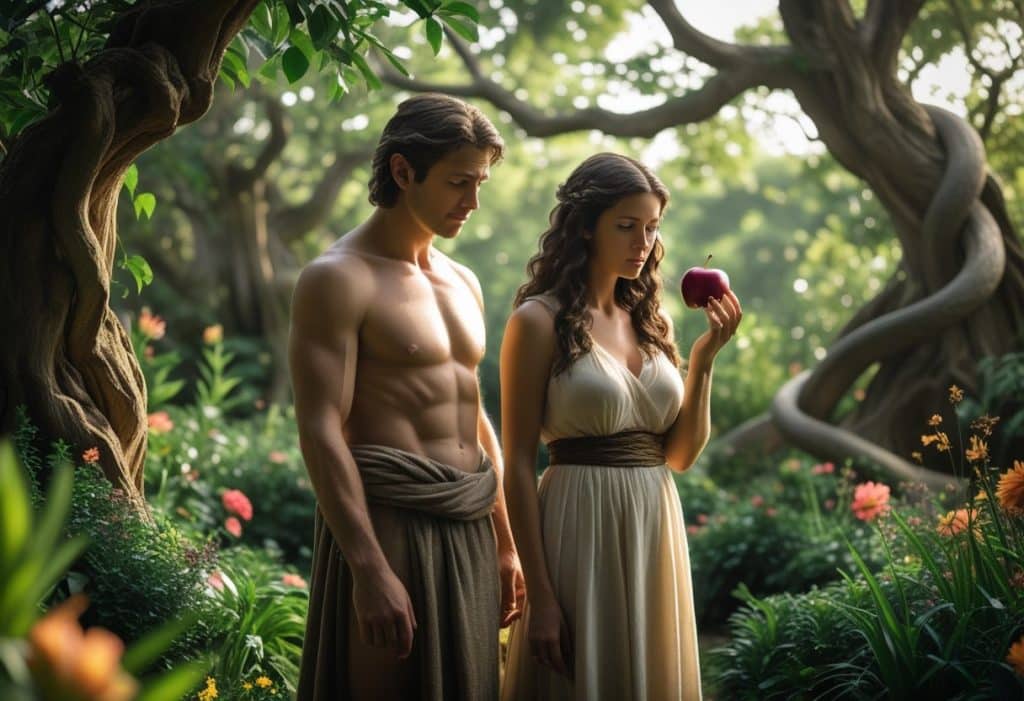
Awareness and the Need for Clothing
Before the Fall, Adam and Eve were naked and unashamed. Their innocence allowed them to enjoy each other’s presence without any sense of shame.
However, once they disobeyed God, their eyes were opened, and they became aware of their nakedness.
This new awareness led to feelings of shame and guilt. They felt the need to cover themselves and fashioned garments from fig leaves.
This shift highlights the deep impact of the Fall, as it transformed their perception of self and each other, leading to a lasting necessity for clothing to shield their vulnerability.
