
The question of what religion Jesus practiced is significant for understanding his life and teachings. Many people ask what religion was Jesus, and the answer lies in his Jewish heritage—he was born a Jew and lived according to the laws and traditions of Judaism.
His roots in first-century Jewish culture shape much of his message, including his teachings on love, justice, and faith. Jesus regularly attended synagogue, observed Jewish customs, and taught from the Hebrew Scriptures.
Understanding his Jewish background provides essential context for the foundation of what would later become Christianity and its connection to the faith Jesus himself practiced.

As he preached about the kingdom of God and the arrival of the Messiah, Jesus appealed to the Jewish faith while also introducing new ideas that challenged existing beliefs.
His roles as a preacher and religious leader are integral to his identity, bridging the gap between Judaism and the emerging Christian faith.
Understanding Jesus’ Jewish background not only sheds light on his actions and teachings but also on the origins of one of the world’s largest religions. His life and message continue to influence billions, making the exploration of his faith relevant to people of all backgrounds.
Historical Context of Jesus
The historical setting of Jesus’ life is crucial to understanding his teachings and the development of Christianity.
Various factors shaped the environment he lived in, including Jewish religious traditions, Roman rule, and the broader geopolitical landscape.
Jewish Sects of the Time
In Jesus’ time, First-Century Judaism was not monolithic. Several sects practiced distinct beliefs and traditions, including the Pharisees, Sadducees, Essenes, and Zealots.
Pharisees: They emphasized the oral traditions and interpretations of Jewish Law. Their ideas greatly influenced later Jewish practice.
Sadducees: This group was associated with the Temple in Jerusalem and held power among the priestly class. They rejected the oral traditions upheld by the Pharisees.
Essenes: They lived in isolated communities and followed strict religious rules. Some scholars believe they may have produced the Dead Sea Scrolls.
Zealots: Focused on resisting Roman authority, they were revolutionary in nature, advocating for Jewish independence.
These groups helped shape the religious and social context in which Jesus preached.
Roman Influence on the Region
The Roman Empire ruled over Israel during Jesus’ lifetime, exerting significant influence on the culture and governance of the area.
Roman Rule: The region was governed by local leaders appointed by Rome, such as Herod the Great, who ruled during Jesus’ birth. He was known for extensive building projects, including the expansion of the Second Temple in Jerusalem.
Cultural Hegemony: Roman customs, laws, and social structures affected daily life. The imposition of taxes and Roman law created tensions among Jews, leading some to view Jesus as a figure of hope against oppression.
These dynamics played a pivotal role in the events leading to his crucifixion.
Geopolitical Landscape
The geopolitical scene of Judea was complex and fraught with tension.
Geography: Jesus lived in a region marked by diverse communities. Bethlehem, his birthplace, is in Judea, while Nazareth and Galilee are in northern territories.
Temple Period: The Second Temple in Jerusalem was central to Jewish worship and identity. It was a focal point for both spiritual and political life.
Maccabean Influence: The Maccabees led a significant rebellion against foreign rule, which contributed to the desire for political autonomy among Jewish people.
Jesus and Jewish Teachings

This section explores the relationship between Jesus and Jewish teachings, focusing on how he interpreted the Torah and engaged with Jewish law and prophecy. It also examines his use of parables and the implications of his messages within the context of Judaism.
Jesus’ Interpretation of Torah
Jesus emphasized the importance of the Torah in his teachings. He called for a deeper understanding of the law, urging his followers to move beyond mere compliance.
In the Sermon on the Mount, he stated that he did not come to abolish the law but to fulfill it. This perspective highlights the significance of intention behind actions, which is a crucial theme in Jewish thought.
He often challenged interpretations of Jewish law, particularly regarding practices like the Sabbath. Instead of strict adherence, he advocated for compassion and mercy, aligning with the Jewish principle of valuing human life.
His debates with religious leaders reflected his desire to clarify the true essence of the law, emphasizing love and justice.
Jewish Prophecies and Jesus
In Jewish tradition, the Messiah is a future leader from the line of King David who will restore Israel and bring peace. Jesus is viewed differently within Judaism; he is not considered the Messiah, as Jews believe the messianic age is yet to come.
Jesus’ actions and teachings were often framed within Jewish prophetic expectations. He spoke about the kingdom of God, portraying a vision of communal harmony.
Many believe his miracles and teachings were meant to fulfill certain predictions found in texts like Isaiah, but they argue that he did not meet all the criteria expected in the Jewish understanding of the Messiah.
Parables and Teachings
Jesus used parables as a teaching tool to convey complex spiritual truths. These stories often drew from everyday life and Jewish customs, making them relatable to his audience. They included themes of justice, mercy, and the importance of faithfulness to God.
In his teachings, he emphasized love for neighbor and enemy alike, reflecting core Jewish values.
His stories often challenged social norms and encouraged a re-evaluation of ethical behaviors among his followers. Parables like the Good Samaritan highlight the significance of compassion, transcending traditional boundaries and emphasizing a broader understanding of community under Jewish law.
Ministry of Jesus
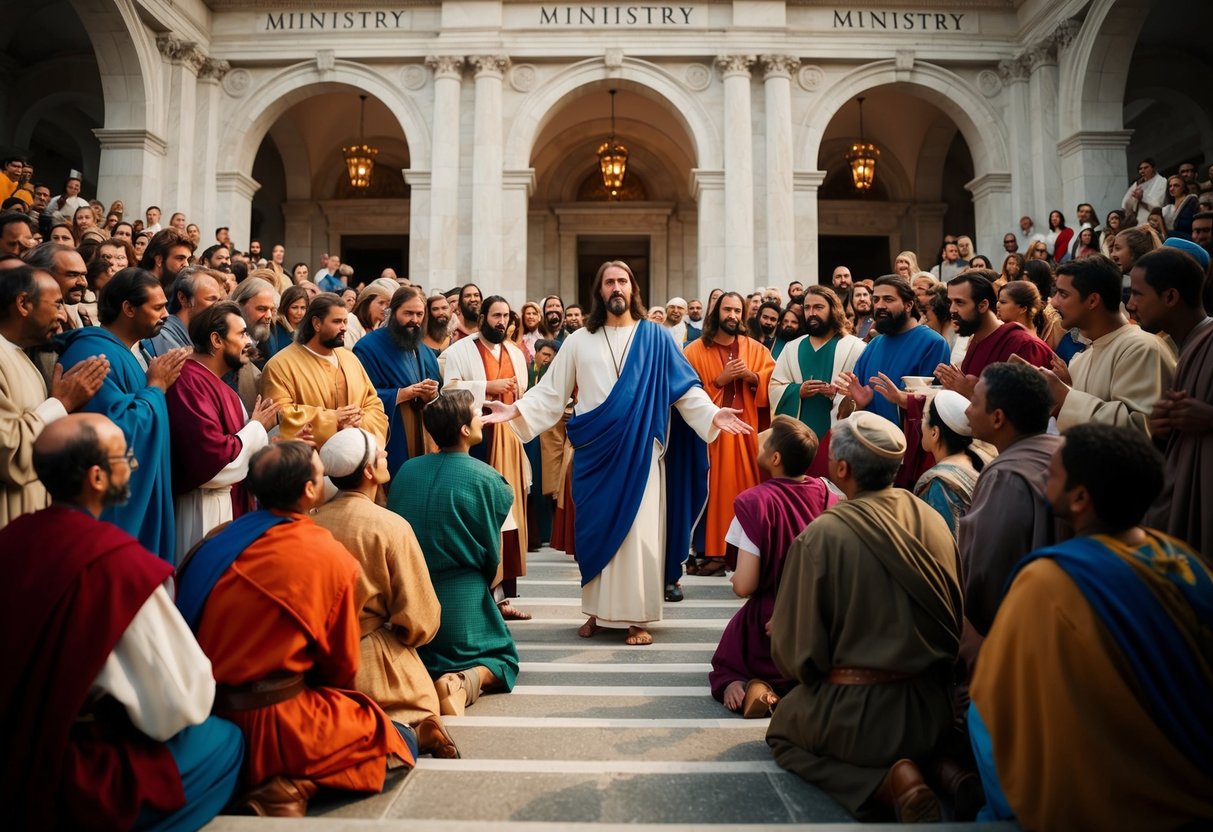
The ministry of Jesus was marked by his teachings, miracles, and the establishment of a movement that would shape religious thought. He gathered followers, performed significant acts, and faced opposition from religious authorities.
Following and Discipleship
Jesus attracted a diverse group of followers who became known as his disciples. These individuals played a crucial role in spreading his message. Among the most prominent were Peter, James, and John, who were part of the inner circle.
He often taught through the use of parables, short stories that conveyed moral lessons. The Gospels of Matthew, Mark, Luke, and John provide insight into how he called disciples, emphasizing the importance of faith and the coming of the Kingdom of God.
Discipleship involved not just acceptance of Jesus’ teachings but also a commitment to follow him, symbolized by actions such as baptism. John the Baptist’s baptizing practices laid the groundwork for this significant moment of commitment.
Miracles as Signs
Miracles were a defining aspect of Jesus’ ministry, serving as signs that underscored his messages. These acts were not only extraordinary but also communicated deeper spiritual truths.
He healed the sick, gave sight to the blind, and even raised the dead.
Miracles showcased his authority and compassion, illustrating the possibility of salvation and restoration. Each miracle told a story, whether it was feeding the 5,000 or turning water into wine, emphasizing themes such as faith and divine intervention.
Through these acts, Jesus invited people to believe in his role as the Son of God, transforming lives and expanding followers’ understanding of faith and community.
Conflict with Authorities
Jesus’ ministry was not without conflict, particularly with religious authorities. His interpretations of Jewish law often challenged traditional practices.
He taught in synagogues and publicly debated with leaders, which led to tension.
The Gospel of John highlights how Jesus’ growing popularity alarmed authorities who saw him as a threat. They feared that his teachings could disrupt the delicate balance of power during a time of political unrest.
Ultimately, this conflict contributed to the events leading to his arrest and crucifixion. The opposition he faced reflected broader issues of faith, authority, and the roles of religion and politics in society.
Death and Resurrection
The events of Jesus’ trial, crucifixion, and resurrection are pivotal in Christian belief. These moments not only highlight historical facts but also shape theological understanding of salvation and eternal life.
Trial and Crucifixion
Jesus faced trial under Pontius Pilate, the Roman governor. His arrest followed challenges posed by religious leaders, including the Sanhedrin, composed of Pharisees and Sadducees. They accused Him of blasphemy for claiming to be the Messiah.
The High Priest questions Him directly, leading to a judgment that calls for His crucifixion. Pilate, after initial reluctance, ultimately sentenced Jesus, influenced by the mob’s demand for His death.
The crucifixion, a common form of Roman execution, occurred at Golgotha. Jesus was nailed to a cross, alongside two criminals.
His death is marked by darkness and earthquakes. Important figures like Mary and Joseph were present, witnessing this tragic end. Jesus’ last words, “It is finished,” signify His fulfillment of divine purpose.
Theological Significance of the Resurrection
The resurrection is central to Christian doctrine. It is seen as God’s ultimate victory over sin, death, and the Devil.
According to the New Testament, Jesus rose on the third day after His crucifixion, demonstrating His divine authority. This event is celebrated during Easter, known as the Festival of the Resurrection.
Through the resurrection, believers gain the promise of eternal life and righteousness.
It signifies the New Covenant, which brings forgiveness and a new relationship with God. The Holy Spirit is believed to act based on this resurrection, guiding believers in their faith journey.
These teachings, primarily found in the Gospels and the Acts of the Apostles, are fundamental tenets of Christianity.
Eyewitness Accounts
Eyewitness accounts play a crucial role in Christian belief about the resurrection. The Gospels describe various post-resurrection appearances of Jesus.
Mary Magdalene was among the first to witness the empty tomb and encountered the risen Christ. This moment is highlighted in the Gospels as a profound event, emphasizing her importance in early Christianity.
Other disciples, like Peter and John, also reported seeing Jesus alive after His death.
These accounts are key in establishing the truth of the resurrection. Historical references, including writings by Josephus, support the existence of early proclamations about Jesus’ resurrection.
Believers see these testimonies as evidence of faith, reinforcing the belief in the resurrection’s significance in their salvation.
Christology and the Formation of the Church
Christology, the study of Jesus Christ’s nature and works, played a vital role in shaping early Christian beliefs and the structure of the Church. Its development influenced how communities viewed Jesus, His teachings, and their own faith as followers of Christ.
Development of Christian Doctrine
The early Church relied significantly on Christology to understand Jesus the Nazarene as both God Incarnate and a human being.
Key events in Jesus’ life, including His birth, death, and resurrection, formed the foundation of Christian doctrine.
These beliefs were articulated through the Canonical Gospels, which presented a structured narrative of Jesus’ mission.
The Nicene Creed emerged in 325 A.D., affirming Jesus’ divine nature and His role as Lord. This doctrine established common beliefs among Christians and countered various heretical views, solidifying the community’s unity.

Early Christian Communities
Early Christian communities developed around the teachings of Jesus and His disciples. These groups were diverse, including Jewish followers and gentiles.
They often met in private homes, sharing meals and scriptures to strengthen their faith.
Communities based their practices on Jesus’ teachings, emphasizing love, service, and faith.
Key texts like the Gospel of Thomas and Gospel of Judas, though not considered canonical, illustrate the variety of beliefs and practices in early groups. These writings reflect the complexity of Christological views and the desire for deeper understanding among early Christians.
Textual Transmission of Jesus’ Teachings
The transmission of Jesus’ teachings was crucial for the formation of the Church.
The New Testament was compiled from various writings, including Paul’s letters and the Gospels. These writings focused on Jesus as the Christos, or Messiah.
Manuscripts such as the Dead Sea Scrolls provided context for understanding Jesus’ message against the backdrop of Jewish tradition.
The early Church sought to ensure accurate transmission, leading to debates about which texts were authentic. This process underscored the importance of preserving Jesus’ teachings for future generations and maintaining doctrinal integrity within the Christian faith.
