
The crucifixion of Jesus is one of the most significant events in human history. When people ask where did Jesus die, the answer points to Golgotha, a skull-shaped hill located just outside the walls of ancient Jerusalem, also known as Calvary.
This sacred site is central to Christianity as the place where Jesus was nailed to a wooden cross. His death here represents not only the end of his earthly life but also the foundation of Christian belief in salvation and eternal life.
Understanding the location and significance of Golgotha helps believers connect more deeply with the sacrifice that defines their faith.

The Crucifixion of Jesus is a central event in the Christian faith, described in the four Gospels of the New Testament.
The location of Golgotha holds deep historical and spiritual meaning for millions around the world. Understanding where this event took place helps illuminate the circumstances surrounding his death and its impact on Christianity.
Through the act of dying on the cross, Jesus became a symbol of sacrifice and redemption for humanity. His death marked a turning point in religious history, forming the basis of Christian teachings about love, sacrifice, and forgiveness. The significance of Golgotha extends beyond its physical location; it remains a powerful reminder of faith and salvation.
Historical Context
The historical context of Jesus’ crucifixion is essential for understanding the events leading to his death.
Several political and religious factors contributed to the situation in Jerusalem during this time, influencing the actions of key figures involved in the trial and execution of Jesus.
Political and Religious Climate
Jerusalem was a tense place in the first century. The city was under Roman control, ruled by Tiberius, who was emperor at the time. The local population faced heavy taxation and strict regulations enforced by Roman soldiers. This created unrest among the Jewish people.
Religiously, the Jewish community was divided into several groups, notably the Pharisees and Sadducees. These groups had different interpretations of Jewish law and often clashed with each other.
Jesus’ teachings challenged the authority of these religious leaders, contributing to their desire to see him punished. This complex environment set the stage for his eventual arrest and trial.
Figures of Authority During the Crucifixion
Key figures played significant roles during the crucifixion of Jesus.
Pontius Pilate was the Roman governor of Judaea. He was tasked with maintaining order in a volatile region and faced pressure from both the Jewish leaders and the local populace.
Herod Antipas, the tetrarch of Galilee, also influenced events. Initially, he was involved in examining Jesus before the trial. The religious leaders sought his support in condemning Jesus. Roman soldiers carried out the crucifixion, emphasizing the brutality of the method used for execution in that era. Their role highlights the power dynamics at play and the collaboration between the Roman authorities and Jewish leaders in this pivotal event.
The Events of the Crucifixion
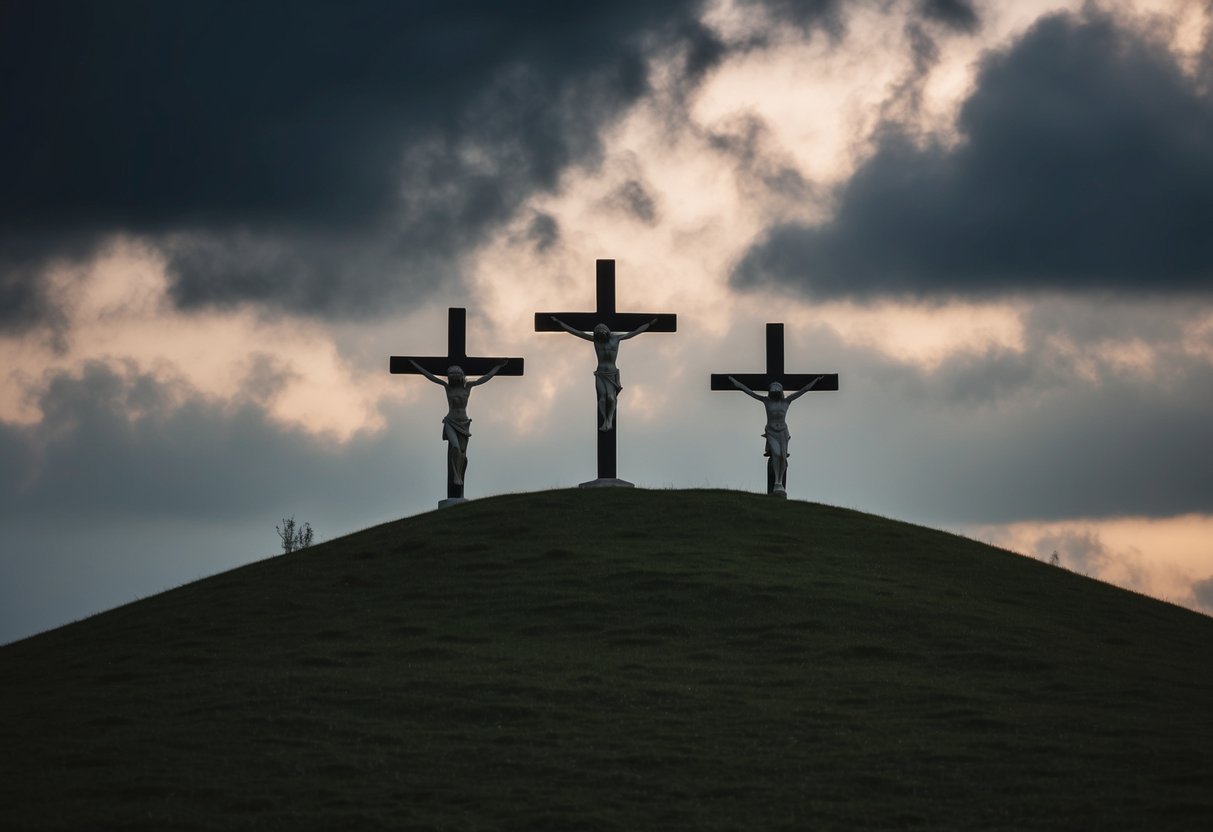
The crucifixion of Jesus is a pivotal moment in Christian history. The events leading up to this moment include his arrest and trial, the painful journey to Golgotha, and the crucifixion itself. Each of these points reveals the significance and gravity of his death.
Arrest and Trial of Jesus
Jesus was arrested late at night in the Garden of Gethsemane after Judas Iscariot betrayed him. He was brought before the Sanhedrin, the Jewish ruling council. During the trial, false witnesses were presented against him. The Gospel accounts highlight that Jesus remained silent during most of the interrogation.
He was accused of blasphemy for claiming to be the Son of God. The high priest ultimately condemned him to death. Unable to carry out the sentence, the Sanhedrin handed him over to Pontius Pilate, the Roman governor. Pilate found no fault in Jesus but succumbed to the crowd’s demands for crucifixion.
The Journey to Golgotha
After his sentencing, Jesus carried his own cross as he traveled to Golgotha, the place of crucifixion. This journey was marked by extreme physical suffering. Due to the severe beating he had endured and the weight of the cross, Jesus struggled under the burden.
To help him, the Romans conscripted Simon of Cyrene, asking him to carry the cross for Jesus. This moment is noted in the Gospel accounts, emphasizing the heavy toll of the ordeal. As they reached Golgotha, the crowd expressed a mix of mockery and sorrow. Jesus was mocked with a crown of thorns placed on his head and an inscription reading “King of the Jews” added above him.
The Act of Crucifixion
Crucifixion was a brutal and public method of execution. When they arrived at Golgotha, Jesus was nailed to the cross. The Gospel accounts describe how he was crucified between two criminals, fulfilling prophetic scripture.
As Jesus hung on the cross, he experienced intense pain and humiliation. The soldiers cast lots for his garments, highlighting his degradation. Despite his suffering, Jesus spoke words of forgiveness, showcasing his compassion. This event marked a monumental moment in Christianity, symbolizing his sacrifice for humanity‘s sins, which is central to the Passion of Christ narrative.
Theological Significance

The death of Jesus holds deep theological meaning in Christianity. It reflects themes of sacrifice, atonement, and the hope of resurrection, forming the foundation of the Christian faith.
Significance of Sacrifice
Jesus’ death is viewed as the ultimate sacrifice for humanity’s sins. According to Christian belief, he was the Messiah sent to fulfill God’s plan for salvation. His willingness to die demonstrates God’s love and grace towards mankind.
Jesus’ death serves as atonement, meaning that it paid the penalty for sin. This act restored the relationship between God and humanity. The belief is that through faith in Christ and his sacrifice, one gains forgiveness and eternal life.
In John 3:16, it is stated that God gave his only Son so that believers would not perish but have everlasting life. This verse captures the essence of his sacrificial role.
Resurrection and Easter
The resurrection of Jesus is central to Christian faith. After his death, he rose on the third day, an event celebrated on Easter Sunday. This resurrection symbolizes victory over sin and death.
For Christians, Easter represents hope and renewal. The belief that Jesus conquers death affirms the promise of eternal life for believers. It emphasizes that through faith, individuals can experience spiritual rebirth.
The resurrection also validates Jesus’ claims of being the Son of God. It serves as a cornerstone for Christian teachings about life after death and the fulfillment of God’s promises.
Biblical Narratives and Scholarly Perspectives
The accounts of Jesus’ death are detailed in the Synoptic Gospels and the Gospel of John. These texts provide rich narratives of the crucifixion, shaping how biblical scholars interpret the historical context. Additionally, historical evidence outside the biblical texts, such as writings by Tacitus, adds depth to the understanding of these events.
Synoptic Gospels and the Gospel of John
In the Synoptic Gospels—Matthew, Mark, and Luke—Jesus’ death is described as a culmination of conflict with religious leaders. In Matthew 27, specific details are presented, including the trial, crucifixion, and notable events like the darkness during the afternoon. The Gospels emphasize themes of fulfillment of prophecy and redemption.
The Gospel of John offers a different perspective. It presents a more theological approach, highlighting Jesus’ control over his fate. John’s account includes the intimate conversations between Jesus and Pilate, demonstrating the tension between power and fate. This narrative underscores that Jesus’ death was part of a divine plan.
Historical Evidence Outside the Bible
Historical evidence outside the Bible supports the biblical narratives. Roman historian Tacitus provides a non-Christian perspective, mentioning Jesus’ execution under Pontius Pilate. His writings affirm that Jesus was a real historical figure and highlight the method of crucifixion, consistent with biblical accounts.
Scholars often examine these external references to gain a fuller understanding of the context and implications of Jesus’ death. This information allows for a broader view of how Jesus is viewed across various traditions and historical frameworks, enriching the discussions around his life and crucifixion.
Aftermath and Influence on Christianity
The events following Jesus’ death significantly shaped the foundations of Christianity. This period included the immediate effects of his death and burial, leading to a rise in the early Christian movement.
Immediate Aftermath and Burial
After Jesus died, his body was taken down from the cross by Joseph of Arimathea. He placed Jesus in a tomb, which was sealed with a large stone. This action fulfilled Jewish customs regarding burial, especially during Passover.
Three days later, reports emerged of Jesus’ resurrection. This event transformed his followers, who saw it as proof of his divine nature. This belief spread quickly among his disciples and the early church, igniting a movement that challenged the prevailing religious norms.
Impact on Early Christianity
The resurrection became a central theme for early Christian writers. They emphasized its significance as proof of life after death and the promise of salvation.
This message resonated with many, leading to conversions and the establishment of new communities.
However, the early Christians faced persecution from both Jewish authorities and Roman governance. Despite this, their faith strengthened as they shared stories of Jesus’ life and resurrection.
Their boldness and unity helped solidify a growing movement that would eventually spread throughout the Roman Empire. This groundwork laid the foundation for what would become one of the world’s major religions.
