
The location of Jesus’ burial site has captivated believers and historians for centuries. Among the most frequently asked questions by those exploring the Holy Land is: Where is Jesus’ Tomb? This inquiry touches the very heart of Christian faith and the historical events that shaped Western civilization.
Most scholars point to the Church of the Holy Sepulchre in Jerusalem’s Old City as the most likely location.
This ancient basilica, constructed by Emperor Constantine in the 4th century, encompasses both Golgotha and the tomb where Jesus was laid to rest, making it one of the world’s most sacred pilgrimage destinations.
Some visitors also explore the Garden Tomb as an alternative site. Located just outside the old city walls, this peaceful garden offers a contemplative atmosphere for those seeking a quieter reflection on the resurrection story.
Various accounts in the Bible detail the burial of Jesus, highlighting Joseph of Arimathea’s role in providing his own tomb for this purpose.
His burial place is described as a new tomb cut into rock, which adds to the intrigue surrounding the exact location.
Although there are other proposed sites, such as the Garden Tomb, the Church of the Holy Sepulchre remains the most widely accepted location for Jesus’ final resting place.
Exploring these locations not only uncovers the physical aspects of Jesus’ burial but also invites deeper reflection on its spiritual significance within the context of Christianity.
The tomb serves as a symbol of hope and resurrection for millions, making the search for its precise location a meaningful journey for many believers and historians alike.
Historical Context and Significance
The tomb of Jesus holds great importance in both historical and religious contexts. Examining biblical references and early literary evidence provides insight into the events surrounding Jesus’ death and resurrection. This section also explores the historical evidence that scholars consider when analyzing the significance of the site.
Biblical Descriptions and Gospels
The New Testament Gospels contain the primary accounts of Jesus’ death and burial.
After the crucifixion, it is detailed that Joseph of Arimathea, a member of the Sanhedrin, requested Jesus’ body. He placed it in a rock-cut tomb, fulfilling Jewish burial customs.
The Gospels emphasize the tomb’s role in the narrative of the resurrection.
Accounts in Matthew, Mark, Luke, and John describe how women first discovered the empty tomb. These texts suggest that Roman soldiers guarded the site to prevent any theft or claims of resurrection. Such details are essential for understanding the foundational events of Christianity.
Historical Evidence and Academic Consensus
Scholars often debate the exact location of Jesus’ tomb. Most agree that it lies within the Church of the Holy Sepulchre in Jerusalem. This site has been recognized since the 4th century as significant to Christians.
Historical evidence is drawn from various sources.
Early literary evidence from writers like Eusebius supports the tradition of this tomb’s location. Additionally, archaeological findings have uncovered tombs that match biblical descriptions.
While there is no definitive proof, the consensus suggests that this site remains central to understanding Jesus’ life, death, and resurrection. The convergence of biblical accounts and historical analysis strengthens its importance in Christian heritage.
The Church of the Holy Sepulchre
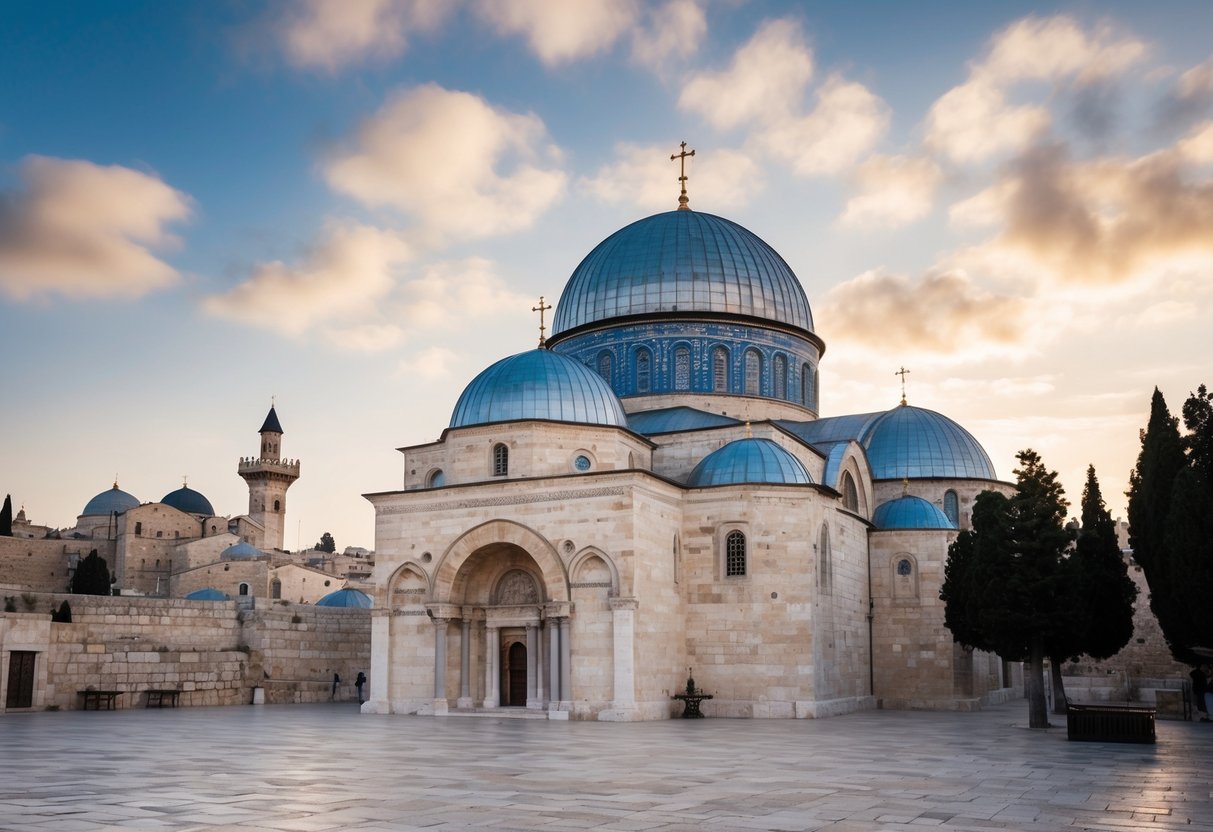
The Church of the Holy Sepulchre is one of the most important sites in Christianity, believed by many to mark the location of Jesus’s crucifixion and burial. Built on the traditional site in Jerusalem, it features notable elements that draw both pilgrims and historians alike.
The Edicule: Heart of the Church
At the center of the Church lies the Edicule, a small shrine that encompasses the tomb of Jesus. The Edicule was originally built in the 4th century by Roman Emperor Constantine after he commissioned the church.
This structure is divided into two main chambers: the antechamber and the tomb itself.
Visitors often notice the marble cladding that covers the Edicule, which was added during various restoration efforts to protect the tomb. The Edicule symbolizes the Resurrection, serving as a focal point for worship and pilgrimage.
Access to the Edicule is available to all who visit, allowing them to pay their respects at this sacred site. It reflects deep historical and religious significance for countless Christians around the world.
Restoration and Conservation
Over the centuries, the Church of the Holy Sepulchre has undergone many restoration and conservation projects. The structure suffered from damage, which required careful attention to maintain its integrity.
In 2016, a major restoration of the Edicule was completed. This project aimed to stabilize the structure and preserve it for future generations.
Experts carefully removed layers of grime and repaired the marble, ensuring that the Edicule remains a protective covering for the tomb.
Efforts are made to balance preservation with the needs of the many visitors. These conservation challenges highlight the significance of the Church as a living monument and a symbol of faith for millions.
Archaeological Investigations
Archaeological investigations surrounding the location of Jesus’ tomb have produced significant findings and ongoing debates. Two key sites often discussed are the Garden Tomb and the Talpiot Tomb. Each holds differing theories about the burial place of Jesus, informed by various archaeological techniques and evidence.
The Garden Tomb
The Garden Tomb is a popular site located outside Jerusalem’s walls. Some believe it to be the actual burial place of Jesus.
This rock-cut tomb fits descriptions found in the New Testament and is near the traditional location of Golgotha, or Calvary.
Archaeologists have performed various studies here, including Optically Stimulated Luminescence, to date the tomb’s formation.
The results suggest it dates back to the first century AD, aligning with the time of Jesus’ crucifixion. Additionally, the landscape displays signs of an ancient garden, supporting its claim of being a burial site. However, without direct evidence linking it to Jesus, its status remains debated.
The Talpiot Tomb Debate
The Talpiot Tomb, discovered in 1980, sparked controversy due to its contents. This limestone quarry contains several burial niches and inscriptions, including names like Jesus, Mary, and Joseph. Some argue this could indicate a family tomb related to Jesus.
Archaeological evidence in the Talpiot site has faced scrutiny.
The National Technical University of Athens has conducted analyses, revealing potential connections to Jesus’ era. Critics, however, challenge these claims, stating that common names make it difficult to draw definitive links.
Rock-cut tombs similar to Talpiot’s can be found throughout the region, complicating its uniqueness. Ongoing debates continue as archaeologists examine texts and materials found within the tomb, exploring their significance to understanding Jesus’ burial.
Cultural and Religious Perspectives
The burial site of Jesus holds deep cultural and religious significance for many faith traditions. Its meaning extends beyond history to influence celebrations and attitudes towards unity among Christians. This section explores how Easter celebrations and varying denominational views shape perspectives on Jesus’ tomb.
Easter Celebrations and Christian Unity
Easter is the most important celebration in Christianity. It commemorates the resurrection of Jesus, which is central to the faith.
On Good Friday, Christians remember the crucifixion. On Easter Morning, they celebrate the resurrection, often gathering for sunrise services.
Different denominations emphasize the tomb in their rituals.
For many, visiting holy sites reinforces their faith and community. The tomb signifies hope and rebirth, promoting a shared understanding among followers.
These celebrations encourage unity among various Christian groups, including Greek Orthodox and Roman Catholic traditions. Despite differing traditions, they all recognize the significance of the tomb in their worship, strengthening their communal ties.
Interdenominational Views
The views on Jesus’ tomb can vary between denominations, influencing how each group honors this sacred site.
Roman Catholics focus on the resurrection’s role in salvation, viewing the tomb as a symbol of victory over death. Greek Orthodox Christians also celebrate the resurrection but have unique customs tied to their heritage and rituals.
Interdenominational discussions often arise regarding the meaning and location of the tomb.
While some advocate for specific historical sites, others emphasize the spiritual essence of the tomb rather than its physical location. These conversations can enhance understanding and foster respect among different faith traditions, further promoting unity within Christianity.
Alternative Theories and Locations
Various theories and locations have emerged regarding the site of Jesus’ burial. Each theory presents distinct arguments and evidence, often based on historical and archaeological findings. The search for the true location of Jesus’ tomb continues to intrigue many.
The Talpiot Family Tomb
The Talpiot Family Tomb gained attention in the late 20th century when researchers suggested it could belong to Jesus and his family.
Discovered in 1980, this grave site contains several ossuaries, or bone boxes, with inscriptions that some interpret as names linked to Jesus’ family, such as “Jesus son of Joseph.”
Supporters of this theory argue that the tomb’s features align with Jewish burial practices of the time. However, many scholars reject this claim, noting the commonality of names during that period. The tomb’s association with Hadrian also casts doubt, as he built a pagan shrine on the site later. Critics emphasize a lack of definitive proof connecting it directly to Jesus.
Other Burial Sites
Other locations also spark debate about Jesus’ burial. The Garden Tomb is one of the most notable. It was proposed in the 19th century as a possible site due to its resemblance to gospel descriptions.
Located north of the Old City walls, this tomb reflects the rock-cut style typical of the era.
Contrarily, another theory involves Joseph of Arimathea, who is said to have provided the tomb for Jesus. Some assert that Jesus was buried in a nearby Jewish Cemetery.
Supporters of this idea cite biblical texts referencing the wealthy man as crucial in the burial process, involving figures like Nicodemus in the preparation.
