
Millions of Christians around the world seek to deepen their faith by traveling to significant historical sites in the Holy Land. When planning a pilgrimage to Jerusalem, the most profound question often arises: can you visit Jesus’ tomb today?
The answer is a resounding yes. Visitors can indeed explore this sacred site, most notably within the church of the Holy Sepulchre, allowing them to connect physically with a cornerstone of their faith.
Standing at the location where Christ was laid to rest and subsequently rose offers a unique spiritual experience, bridging the gap between ancient history and modern belief.
The Tomb of Jesus is housed within the church of the Holy Sepulchre, which is one of the most revered locations for Christian pilgrimage. This church stands on the site believed to be where Jesus was buried after his crucifixion.
Many pilgrims are drawn to this place to reflect on the resurrection and the impact of Jesus Christ on their lives.
In addition to the church of the Holy Sepulchre, there is also a site known as the Garden tomb, which some believe represents the burial location. Both places provide unique perspectives and experiences for those wishing to honor the legacy of Jesus. They offer a tangible connection to the faith and history that shape Christianity today.
Historical Background of the Tomb
The tomb associated with Jesus has significant roots in biblical texts and early Christian history. These accounts provide insights into its origin and the individuals involved in its creation and burial.
Biblical References
The Gospel accounts offer details about the burial of Jesus after his crucifixion. According to the Gospels, Joseph of Arimathea played a key role. He was a member of the Sanhedrin and a secret disciple of Jesus.
Joseph requested Pilate for the body of Jesus after his death. In Matthew 27:60, it states that Joseph took the body and laid it in his own new tomb.
John 19:41 also mentions that the tomb was located in a garden near the crucifixion site. This highlights that the tomb was unused and vital in the early Christian narrative. The fact that it was a new tomb adds to its significance, as it was prepared specifically for this occasion.
Early Christian Accounts
Early Christian texts often emphasized the importance of Jesus’ tomb. The tomb’s location became a site of reverence and pilgrimage for followers.
Accounts from early Christians, including those outside the canonical Gospels, suggest that it held deep significance, representing hope and resurrection. Church traditions indicate that over the centuries, various structures were built around the tomb, pointing to its revered status.
These historical developments show how the tomb transitioned from a burial site to a significant spiritual landmark. Pilgrims from around the world visit, underlining its lasting impact and emotional weight in Christianity today.
The Church of the Holy Sepulchre

The Church of the Holy Sepulchre is a significant religious site, believed to be the location of Jesus’ crucifixion, burial, and resurrection. Its rich history includes key elements such as its founding by Emperor Constantine, the prominent Edicule structure, and various archaeological findings that provide insight into its past.
Founding by Emperor Constantine
Emperor Constantine established the Church of the Holy Sepulchre in the fourth century C.E. after converting to Christianity. Seeking to honor Jesus’ memory, he commissioned the church to be built over what was believed to be the site of the crucifixion and burial.
Construction began in 326 C.E. and was completed in 335 C.E. The church was built using local limestone, showcasing early Christian architecture.
It has undergone various renovations and reconstructions throughout the centuries due to damage from fires and wars.
Constantine’s vision helped establish Christianity as a major religion, and the church quickly became a pilgrimage destination. Its historical significance continues to attract thousands of visitors every year.
The Edicule and its Significance
The Edicule is a small structure located within the Church of the Holy Sepulchre. It surrounds the tomb where Jesus is believed to have been buried. This sacred space is also the focal point for many Christian pilgrims.
Originally built in the early church, the Edicule has faced destruction and rebuilding. The current structure dates back to the 19th century, following a fire that damaged earlier versions.
Inside the Edicule, a marble slab marks the burial place of Jesus, drawing many worshippers.
The Edicule symbolizes the resurrection, a key tenet of Christianity. It serves not only as a historical monument but also as a place of prayer and reflection for those seeking spiritual connection.
Archaeological Evidence
Archaeological findings around the Church of the Holy Sepulchre have enhanced understanding of its historical context. Excavations reveal remnants of a first-century tomb, supporting the belief that this site may be where Jesus was buried.
Additional artifacts, such as early Christian writings and structures, contribute to the site’s importance. For example, marble and other materials used in building parts of the church have been analyzed, revealing insights about construction techniques in ancient times.
Ongoing research continues to uncover layers of history, making the Church of the Holy Sepulchre a rich source of information for scholars and historians alike. The integration of faith and archaeology creates a unique narrative about early Christianity.
The Garden Tomb Alternative
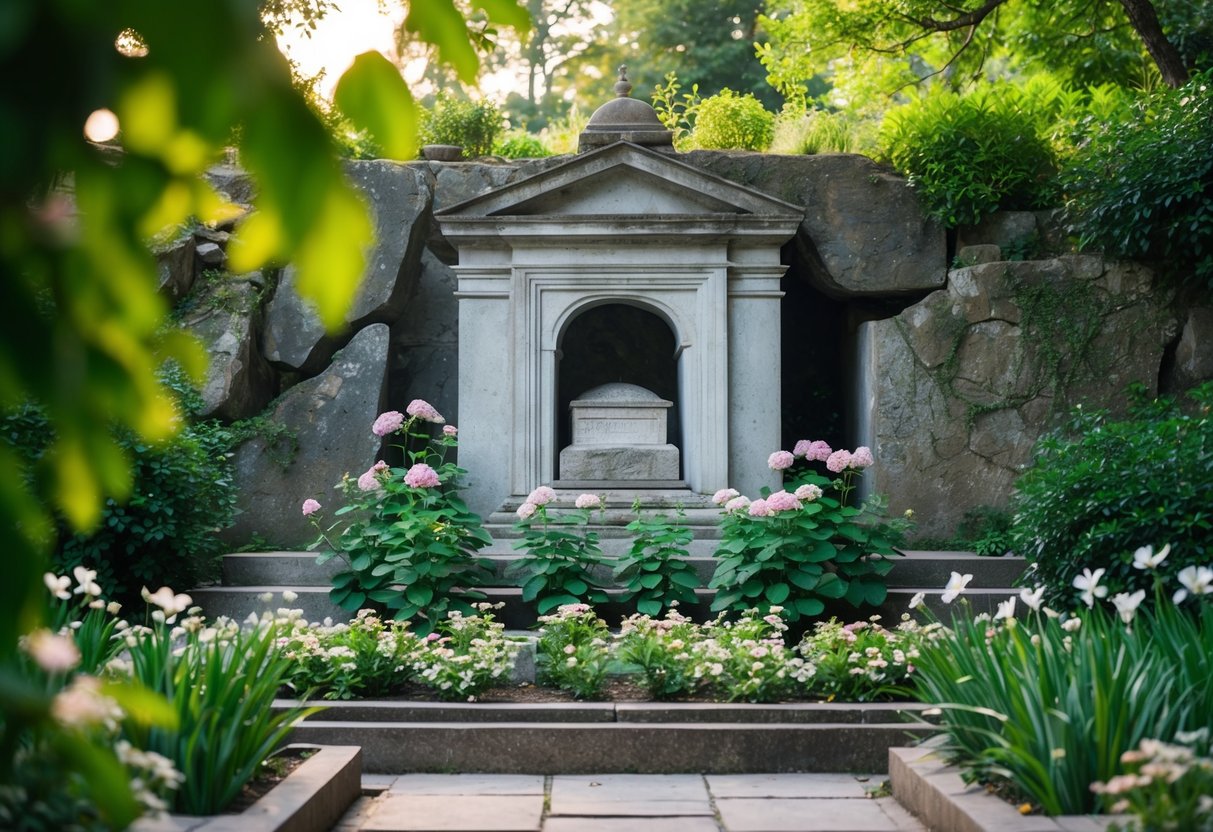
The Garden Tomb, also known as Gordon’s Tomb, offers an alternative location for those interested in the burial site of Jesus. This site, discovered in the 19th century, features a natural setting that many visitors find peaceful and reflective.
Discovery and Features
The Garden Tomb was identified in the 1800s by Charles Gordon. He believed it to be the burial place of Jesus based on its proximity to a rocky skull-shaped hill, known as Golgotha. This tomb is hewn out of the rock and features a burial chamber that reflects the style of first-century tombs.
Visitors often notice the serene garden surrounding the site, which adds a tranquil atmosphere for reflection and prayer. The tomb itself has an entrance that is lower than most, leading into a simple, carved space.
This contrasts with the more elaborate Church of the Holy Sepulchre, offering a different historical and spiritual perspective on Jesus’ burial.
Protestant Support and Visitation
The Garden Tomb has gained wide support from Protestant groups. Many see it as a fitting memorial for Jesus’ resurrection, emphasizing simplicity and sincerity in worship. This site is managed as a non-denominational space, welcoming visitors from various backgrounds.
Daily tours are available, and special services are held throughout the year. Visitors can explore the garden, meditate, or join guided tours to learn more about its significance.
With its accessible location, the Garden Tomb attracts multiple visitors each day, eager to experience a connection to biblical history in a unique setting.
Visiting Jesus’ Burial Sites
Many people visit the burial sites of Jesus, exploring their spiritual significance. These sites are vital to pilgrims, allowing for moments of quiet contemplation and deepened faith.
Pilgrimage and Faith
For centuries, pilgrims have traveled to Jerusalem, seeking to visit the burial sites of Jesus. The most recognized locations are the Church of the Holy Sepulchre and the Garden Tomb. Each site claims to be the true burial place of Jesus, allowing visitors to choose their own spiritual journey.
Many go during Holy Week, participating in religious ceremonies and reflecting on the events leading to the crucifixion. Walking the paths of Golgotha, or Calvary, adds to the experience, connecting pilgrims to historical events. This pilgrimage serves as a powerful expression of faith.
Experiencing the Sacred
Visitors often describe a feeling of reverence when at these significant sites. The Church of the Holy Sepulchre is adorned with religious symbols and artwork that emphasize its importance. Quiet areas enable contemplation, where individuals can pray and reflect.
The Garden Tomb offers a peaceful environment, filled with gardens and open spaces. Here, visitors can contemplate the resurrection of Jesus, enhancing their spiritual experience. Both sites provide an opportunity for deep personal reflection, making them essential for those seeking connection to their faith.
Debate on Authenticity
The authenticity of Jesus’ tomb is a topic of significant debate among scholars, archaeologists, and religious followers. Two primary sites are often discussed: the Church of the Holy Sepulchre and the Garden Tomb.
Views on the Holy Sepulchre
The Church of the Holy Sepulchre is widely accepted by many Christians as the site of Jesus’ burial and resurrection. This location has a rich history and has been a place of pilgrimage since ancient times. Archaeologists highlight the site’s numerous historical and archaeological findings that support its authenticity.
Some argue that the structure’s age and traditions make it more credible. The church marks the location where Jesus’ body was believed to be laid after the crucifixion. The empty tomb within the church draws millions of visitors each year, reinforcing its status as a significant religious site.
Garden Tomb Controversies
The Garden Tomb presents an alternative view, with some proponents claiming it as the true burial site of Jesus.
Supporters argue that its geographical features align more closely with the gospel accounts of the crucifixion and burial. They emphasize the simplicity of the tomb, contrasting it with the ornate Holy Sepulchre.
Critics, however, point out that there is limited historical evidence to support the Garden Tomb’s claims.
Archaeologists often note that there are many tombs from the period, complicating any definitive conclusions.
The ongoing debate fuels interest and exploration, keeping the discussion lively over the authenticity of Jesus’ burial site.
