
The foundation of Christian theology is deeply rooted in scriptural authority, yet for those new to the faith, a fundamental question often serves as the starting point.
Readers frequently ask: Is Jesus in the Bible merely as a historical figure, or is he the central theme of the entire book? The answer is that he is not only mentioned throughout the New Testament, but he is the focal point of its message, often referred to as the good news.
From his birth in the Gospels to His teachings, miracles, and ultimately his sacrifice, he is woven into the very fabric of the text. His presence transforms the scripture from a history book into a living testament of faith.

Beyond the New Testament, various interpretations suggest that elements of Jesus’ life and mission can also be found in the Old Testament. These references point to prophecies and symbols that many Christians connect to Jesus’ identity as the Messiah.
Thus, exploring the Bible reveals a deeper narrative that points back to the significance of Jesus in both testaments.
For those seeking to understand the role of Jesus in Christianity, examining these texts provides insight into his life, teachings, and what they mean for believers today.
Reading the Bible not only uncovers the story of Jesus but also invites reflection on its impact on faith and daily life.
Historical Context of Jesus in the Scriptures
The historical context of Jesus in the Scriptures is rooted in both the Old and New Testaments. These texts provide a framework for understanding how Jesus fulfills Old Testament prophecies and how the New Testament chronicles his life and teachings.
The Prophetic Foretelling in the Old Testament
The Old Testament contains many prophecies about the coming Messiah.
Key texts include Isaiah, which speaks of a suffering servant, and Micah, which mentions Bethlehem as the birthplace of the Messiah. These prophecies set the stage for Jesus’s arrival.
The Hebrew scriptures hinted at the nature and mission of the Messiah. For example, Isaiah 7:14 predicts a virgin birth, and Isaiah 53 describes the suffering the Messiah would endure.
These prophetic elements are critical as they help identify the significant moments in Jesus’s life.
These insights also guide readers in understanding why first-century Jews were expecting a Messiah. Many believed he would save them from oppression and establish God’s kingdom on Earth.
The Account of Jesus in the New Testament
The New Testament primarily consists of the Gospels: Matthew, Mark, Luke, and John. These texts record Jesus’s life, teachings, miracles, death, and resurrection.
Each Gospel writer presents a unique perspective, reflecting different audiences and theological emphasis.
For instance, Matthew emphasizes Jesus’s role as the fulfillment of Old Testament prophecy. He often references Hebrew scripture to connect Jesus’s actions to these prophecies.
Mark, on the other hand, focuses on the immediacy of Jesus’s ministry.
In addition to the Gospels, the New Testament includes letters from early church leaders that discuss the significance of Jesus’s life and teachings.
These writings help frame Jesus not just as a historical figure, but as central to Christian faith and theology.
By examining both the Old and New Testament contexts, one can grasp how Jesus is portrayed throughout the Scriptures.
The Birth and Early Life of Jesus

The story of Jesus begins with his miraculous birth and his early childhood. Understanding these events is key to recognizing his significance in religious traditions.
Virgin Birth and Fulfillment of Prophecy
Jesus was born in Bethlehem to Mary, who was a virgin. This event was predicted in the Bible, fulfilling ancient prophecies.
Joseph, Mary’s fiancé, was initially troubled by her pregnancy. However, an angel appeared to him in a dream, confirming that the child was conceived by the Holy Spirit.
At the time, a census required Joseph and Mary to travel from Nazareth to Bethlehem. While in Bethlehem, Mary gave birth to Jesus. He was laid in a manger because there was no room in the inn.
This humble setting highlights the significance of his birth. Shepherds were the first to hear the announcement of his birth by angels, showcasing the special role they would play in the early life of Jesus.
Early Years in Nazareth and Judea
After Jesus’s birth, the family fled to Egypt. This was to escape King Herod’s decree to kill all young boys in Bethlehem.
Once Herod died, they returned and settled in Nazareth in Galilee.
Jesus grew up there in a typical Jewish household. He was obedient to his parents, and scripture mentions his increasing wisdom and stature.
At age twelve, he visited the Temple in Jerusalem, demonstrating his understanding of spiritual matters. These early years played a crucial role in shaping Jesus’s character and future ministry.
Ministry and Teachings of Jesus
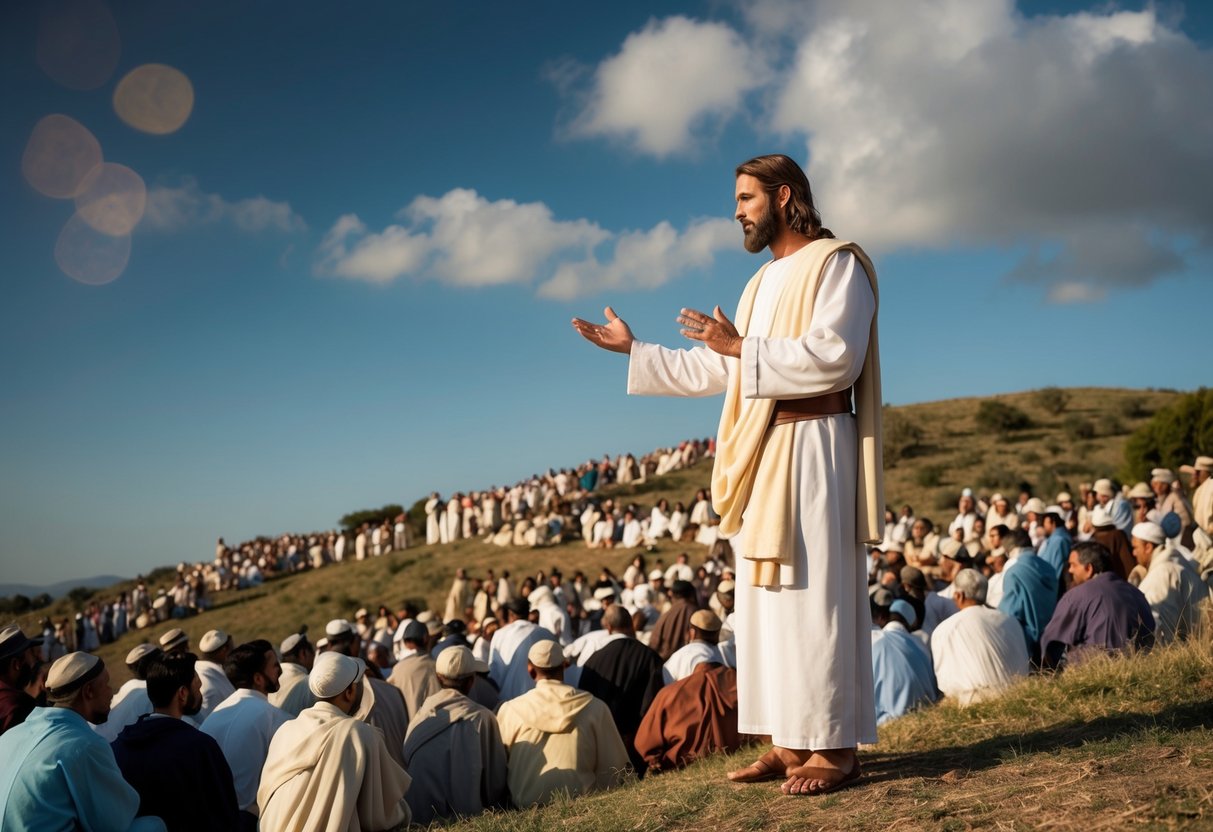
Jesus’ ministry involved performing miracles, teaching parables, and promoting peace. His role as a religious leader shaped the early understanding of God and salvation in Christianity.
Through his actions and messages, he revealed the nature of the Messiah and his identity as the Son of God.
Miracles and Parables
Jesus performed many miracles, which were central to his ministry. These acts demonstrated his divine authority and compassion.
Notable examples include healing the sick, feeding the hungry, and even raising the dead. Each miracle illustrated his power over sin and suffering.
His parables, simple stories with deeper meanings, taught important lessons about faith, love, and the Kingdom of God.
For instance, the Parable of the Good Samaritan emphasizes love for one’s neighbor, while the Parable of the Prodigal Son highlights God’s forgiveness. These teachings helped followers connect with spiritual truths.
Promoting Peace and Reconciliation
Jesus emphasized peace and reconciliation throughout his teachings. He taught his followers to love their enemies and to seek peace in conflict.
In the Sermon on the Mount, he stated, “Blessed are the peacemakers, for they will be called children of God.” This message resonated with those seeking hope amid turmoil.
Moreover, Jesus brought together diverse groups, breaking social boundaries. His interactions with tax collectors, sinners, and Samaritans illustrated his mission to seek and save the lost, reinforcing the idea that everyone is worthy of salvation and grace.
Jesus as a Religious Leader
As a religious leader, Jesus held a unique position.
He was seen as the High Priest who offered a new covenant through his teachings and sacrifice. His followers recognized him as the Lamb of God, who would take away the sins of the world.
Jesus’ teachings often challenged established religious practices, emphasizing a personal relationship with God over strict adherence to laws.
He invited people to experience the Holy Spirit, bringing them closer to God. Through his life and work, he clarified the path to salvation for all who believe in him.
The Crucifixion and Resurrection
The Crucifixion and Resurrection of Jesus are central events in Christianity. They represent not only his trial and suffering but also the foundation of hope for eternal life through his resurrection.
Trial and Suffering
Jesus faced significant trial before His crucifixion.
Accused of blasphemy, he stood before religious leaders and Roman officials. He was declared guilty, despite living a sinless life. His claims of divinity, including calling Himself “I am,” angered many.
During this time, Jesus endured mockery and physical suffering. He was beaten and forced to carry His cross to Golgotha, the site of His execution.
The crucifixion was a brutal process, where nails were driven through his hands and feet. As he hung on the cross, he experienced both physical pain and spiritual anguish.
His last words emphasized his love and forgiveness, even toward those who persecuted him.
Significance of the Resurrection
The resurrection of Jesus is celebrated as the cornerstone of Christian belief.
Three days after his death, he rose from the dead, providing proof of his divine nature and fulfillment of Scripture.
This event is significant because it offers believers the promise of eternal life. It signifies victory over sin and death. Because of the resurrection, Christians believe that faith in Jesus ensures salvation.
The resurrection transformed Jesus’ followers, turning them into bold proclaimers of his message across Jerusalem and beyond. This led to the spread of Christianity and the belief that through Jesus, anyone can be saved.
Together, the crucifixion and resurrection are profound not just for their historical context but also for their ongoing impact on faith and hope.
Impact and Legacy
The impact of Jesus as portrayed in the Bible is profound and transformative. His teachings formed the basis of the early Church and continue to shape modern Christianity.
The legacy of Jesus revolves around themes of salvation, reconciliation, and the role of the Holy Spirit in believers’ lives.
Formation of the Early Church
After Jesus’ resurrection, His disciples played a crucial role in forming the early Church.
They spread his teachings, known as the good news, emphasizing love, repentance, and forgiveness. The Holy Spirit empowered them, guiding their mission to share the message of salvation.
These early Christians faced persecution but remained steadfast.
Their commitment to community and worship laid the groundwork for Christian practices.
They established rituals such as baptism and communion, which still hold significance today.
Ongoing Influence on Modern Christianity
Jesus’ legacy persists in contemporary Christianity. His teachings influence millions, encouraging believers to embody his message through acts of love and service.
Concepts like reconciliation and salvation remain central to Christian faith.
Modern churches often reference Jesus’ parables to inspire ethical living. The call to love one’s neighbor and seek justice reflects his teachings.
Additionally, the ongoing work of the Holy Spirit is vital for guidance and empowerment in believers’ lives.
Through various denominations, the impact of Jesus continues to unite and inspire Christians around the world.
